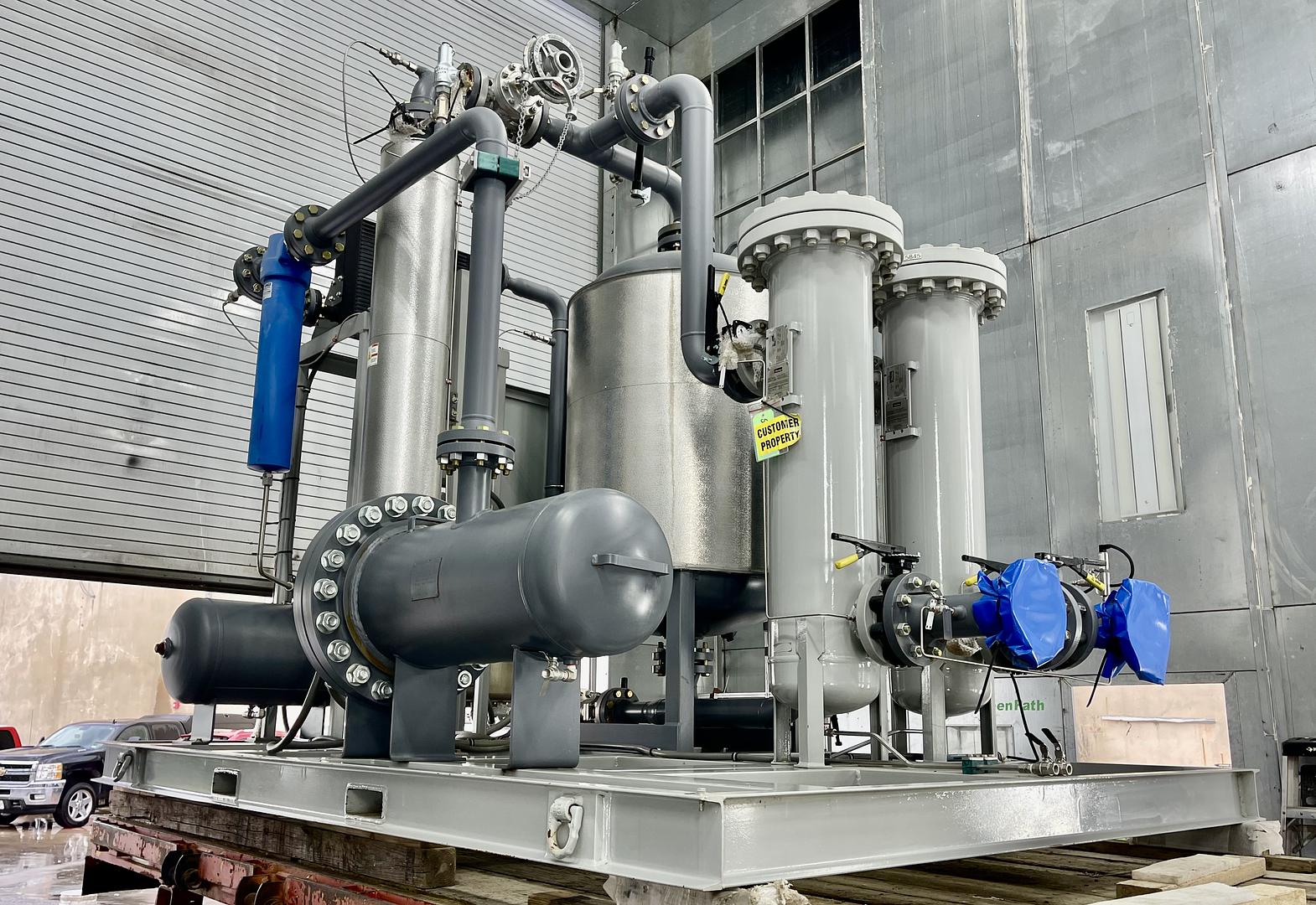
LPG equipment leasing vs purchasing is a major engineering and procurement decision for factories, hotels, food processors, agricultural facilities and institutions using bulk LPG. The choice affects capital expenditure, equipment ownership, maintenance obligations, supplier flexibility, compliance responsibilities and the total cost of operating the gas installation.
When a business moves from cylinders or alternative fuels to a bulk LPG installation, the fuel itself is only one part of the investment. The facility may require storage tanks, regulators, valves, vaporizers, meters, pipework, emergency isolation systems, leak detection, control equipment and fire protection.
Related Products
Those assets have to be financed, installed, maintained and eventually replaced.
This is why LPG equipment leasing vs purchasing should be assessed before the commercial LPG supply agreement is finalized.
A business may purchase the entire installation, lease selected equipment, use a supplier-provided tank, or negotiate a hybrid arrangement in which some assets are owned and others are provided under a service agreement.
The cheapest initial option is not necessarily the lowest-cost option over five, ten or fifteen years.
For industrial users, the correct decision requires an assessment of capital expenditure, operating expenditure, LPG consumption, equipment utilization, expected project life, maintenance capability and contractual restrictions.
The engineering specification must also come before the commercial decision. A supplier cannot properly price a system until the storage requirement, gas demand, operating pressure, peak load and distribution arrangement have been established.
For companies evaluating LPG equipment leasing vs purchasing, the central question is therefore not simply, “Which option costs less today?”
The better question is:
Which commercial model provides the safest, most reliable and economically sustainable LPG infrastructure over the expected operating life of the facility?
What Does LPG Equipment Leasing Mean?
LPG equipment leasing allows a business to use specified LPG infrastructure without purchasing all of the equipment outright at the beginning. Depending on the contract, the lessor may also provide maintenance, technical support, inspections or other services in exchange for periodic payments.
Leasing can apply to individual assets or an integrated LPG installation.
A bulk storage tank is one common example. However, leasing arrangements can also involve vaporizers, metering systems, control equipment and other infrastructure.
The commercial structure varies considerably between suppliers.
One agreement may simply provide the physical equipment.
Another may include preventive maintenance.
A more comprehensive arrangement may combine equipment provision, LPG supply, technical support and maintenance.
Consequently, businesses considering LPG equipment leasing vs purchasing must examine the complete contractual scope instead of comparing monthly charges alone.
The contract should clearly identify:
- Equipment being provided
- Equipment ownership
- Lease duration
- Installation responsibility
- Maintenance responsibility
- Inspection requirements
- Repair obligations
- Replacement responsibilities
- LPG supply conditions
- Minimum purchase requirements
- Price-adjustment mechanisms
- Termination provisions
- End-of-contract arrangements
A monthly equipment charge has little meaning if the customer does not know what services are included.
What Does Purchasing LPG Equipment Mean?
Purchasing LPG equipment means the customer acquires ownership of the specified assets and assumes the associated lifecycle responsibilities. The customer normally gains greater control over the infrastructure but must budget for maintenance, inspection, repairs, upgrades and eventual replacement.
For a permanent factory, hotel, food-processing plant or institution, purchasing can create a long-term capital asset.
The customer may own the storage tank, regulators, vaporizer, meter, pipework and associated equipment, depending on the procurement scope.
Ownership can also provide greater commercial flexibility.
If the business changes LPG suppliers in the future, it may not need to return a supplier-owned storage tank or renegotiate infrastructure access.
However, ownership comes with responsibilities.
The business becomes responsible for ensuring that the equipment remains properly maintained, inspected and operated.
The customer should also maintain appropriate technical documentation, inspection records and maintenance histories.
This makes LPG equipment leasing vs purchasing a decision about responsibility as much as it is a decision about finance.
A purchased installation should therefore be accompanied by a lifecycle maintenance strategy from the beginning.
Capital Expenditure and Cash Flow
The most visible difference between LPG equipment leasing and purchasing is the timing of expenditure. Purchasing normally requires greater initial capital, while leasing can distribute equipment-related payments over time and preserve cash for production, expansion or other investments.
Industrial projects often require substantial capital before production begins.
A new factory may already be spending money on:
- Land development
- Buildings
- Production machinery
- Electrical infrastructure
- Water systems
- Warehousing
- Vehicles
- Automation
- Fire protection
- Environmental controls
Adding a complete LPG installation can increase the project’s upfront capital requirement.
Leasing may therefore be attractive to companies that want to reduce initial expenditure.
However, the customer should not automatically conclude that leasing is cheaper.
A lease creates recurring payments.
Over a long period, those payments may exceed the original purchase price by a significant amount.
The customer must therefore compare the total cost over an equivalent period.
A basic lifecycle calculation can be structured as:
Lease Lifecycle Cost = Initial Charges + Lease Payments + Excluded Maintenance + Additional Services + Contractual Charges
For purchasing:
Ownership Lifecycle Cost = Purchase Price + Installation + Financing + Maintenance + Inspection + Repairs + Replacement − Residual Value
These are planning formulas rather than accounting standards, but they illustrate why LPG equipment leasing vs purchasing should be assessed over the full lifecycle.
Total Cost of Ownership Matters
Total cost of ownership provides a more reliable basis for comparing LPG infrastructure options than the purchase price or monthly lease payment alone. The analysis should include installation, maintenance, inspections, repairs, energy efficiency, equipment life, financing, contractual charges and residual asset value.
Consider a facility that expects to operate its LPG system for ten years.
A five-year lease may appear inexpensive because its monthly payments are manageable.
But what happens after year five?
Does the customer renew?
Does the equipment become available for purchase?
Does the supplier remove it?
Does the lease rate increase?
Is the customer required to sign another LPG supply agreement?
These questions affect the real economic outcome.
Likewise, purchasing an LPG system does not mean the customer pays only the equipment price.
Maintenance, inspection and replacement costs must be budgeted.
A vaporizer may eventually require component replacement.
A gas meter may require calibration.
Valves and regulators may require servicing.
Safety systems require periodic testing.
The tank itself requires appropriate inspection and continued compliance.
Therefore, LPG equipment leasing vs purchasing should always be supported by a lifecycle cost model.
Equipment Ownership and Asset Control
Ownership provides control over the LPG infrastructure, while leasing generally gives the customer usage rights for a defined period. The ownership structure affects supplier flexibility, asset value, relocation, upgrades, termination and what happens when the commercial agreement ends.
A purchased LPG installation becomes part of the customer’s asset base.
A leased installation normally remains owned by the leasing company unless the contract states otherwise.
This difference becomes particularly important when the facility expands.
An owned system can potentially be modified or expanded through an appropriate engineering process.
A leased system may require the lessor’s approval.
The contract should therefore address future expansion.
For example:
- Can storage capacity be increased?
- Can another vaporizer be installed?
- Can additional production lines be connected?
- Who pays for upgrades?
- Who owns new equipment?
- Does the lease payment change?
- Does the contract term reset?
Businesses evaluating LPG equipment leasing vs purchasing should ask these questions before signing rather than waiting until expansion becomes necessary.
LPG Tank Leasing and Bulk Storage
LPG tank leasing can reduce the initial capital required for bulk storage, but the commercial arrangement must clearly establish ownership, inspection, maintenance, installation, insurance requirements, replacement responsibilities and end-of-contract procedures.
A bulk LPG tank is not simply a storage container.
It forms part of an engineered installation incorporating filling connections, isolation valves, pressure controls, level measurement, pipework and safety systems.
The tank’s capacity must also correspond with the customer’s consumption and delivery schedule.
An undersized tank may result in frequent deliveries and greater operational exposure.
An oversized tank can increase capital requirements and may not provide economic value if consumption is low.
The tank arrangement should therefore be based on actual demand.
For businesses assessing LPG equipment leasing vs purchasing, the following asset schedule can help clarify responsibilities:
| Asset | Ownership to Confirm | Maintenance Responsibility | Replacement Responsibility |
|---|---|---|---|
| LPG storage tank | Customer or supplier | Contract dependent | Contract dependent |
| Vaporizer | Customer or supplier | Contract dependent | Contract dependent |
| Regulators | Customer or supplier | Defined service schedule | Defined by agreement |
| LPG meter | Customer or supplier | Calibration/service | Defined by agreement |
| Control panel | Customer or supplier | Technical service | Defined by agreement |
| Leak detection | Customer or supplier | Testing and servicing | Defined by agreement |
| Pipework | Customer or supplier | Inspection and repair | Defined by agreement |
| Safety equipment | Customer or supplier | Periodic inspection | Defined by agreement |
The purpose of this table is not to assign universal responsibilities. It is to ensure that the contract does so explicitly.
Maintenance and Technical Support
Maintenance can significantly change the economics of LPG equipment leasing versus purchasing. A lease that includes meaningful preventive maintenance, emergency response and equipment support may provide operational value, while a lease that excludes most technical services may offer little advantage beyond financing.
A maintenance agreement should specify exactly what is covered.
For example, it should identify whether the supplier provides:
- Routine inspections
- Preventive maintenance
- Emergency callouts
- Spare parts
- Calibration
- Regulator servicing
- Vaporizer servicing
- Valve inspection
- Leak testing
- Control-system checks
- Documentation
The customer should also establish response times.
A critical industrial LPG installation may require faster intervention than a low-demand commercial facility.
For an owned system, the customer can appoint a specialist engineering company to provide equivalent maintenance support.
This creates a useful hybrid arrangement:
Owned equipment + contracted technical maintenance.
That model can provide asset ownership while avoiding the need for a customer to maintain specialist LPG engineering capabilities internally.
Businesses considering LPG equipment leasing vs purchasing should compare these service arrangements on an equivalent basis.
Industrial LPG Equipment and System Capacity
The commercial structure should never be selected before the LPG system is technically sized. Storage, vaporization, pressure regulation, pipe diameter, flow capacity and peak demand must be established before comparing equipment costs or lease proposals.
Industrial LPG demand can vary substantially.
A small commercial kitchen may require a relatively modest flow rate.
A manufacturing facility using multiple burners, ovens, boilers or process-heating equipment can require considerably higher capacity.
The engineering design should consider:
- Connected load
- Diversity factor
- Peak demand
- Operating pressure
- Required vaporization capacity
- Storage capacity
- Delivery frequency
- Pipe length
- Pressure drop
- Regulator capacity
- Emergency isolation
- Fire protection
Where vaporization is required, businesses can review high-performance LPG vaporizers as part of the system-design process.
The equipment selection should be based on the actual duty rather than simply choosing the largest available unit.
LPG Equipment Leasing vs Purchasing for Manufacturing
Manufacturing facilities should evaluate LPG equipment leasing vs purchasing against production continuity, process heat requirements, expected operating life and expansion plans. A long-term factory with stable consumption may benefit from ownership, while a capital-constrained project may prefer a lease or managed equipment arrangement.
Manufacturing applications can include:
- Process heating
- Industrial ovens
- Boilers
- Metal treatment
- Food production
- Ceramics
- Textile operations
- Industrial drying
- Thermal processing
For these applications, LPG availability can directly influence production continuity.
A gas system failure may stop a production line.
Consequently, maintenance and spare-parts support should be included in the procurement evaluation.
The commercial arrangement should also account for future capacity.
If production is expected to increase by 30% or 50%, the customer should understand whether the existing installation can be upgraded without renegotiating the entire agreement.
This is another reason LPG equipment leasing vs purchasing should be reviewed as a lifecycle decision.
LPG Equipment Leasing vs Purchasing for Hospitality
Hotels, restaurants and commercial kitchens should assess LPG equipment leasing vs purchasing using kitchen load, occupancy patterns, hot-water demand, seasonal consumption and future expansion. A flexible commercial structure is particularly important where gas demand changes throughout the year.
Hospitality facilities can have highly variable demand.
A hotel may experience increased LPG consumption during:
- Peak tourism seasons
- Conferences
- Weddings
- Large events
- Holiday periods
- High restaurant occupancy
If leased equipment is tied to minimum LPG purchases, these variations must be considered.
A contract designed around average consumption may become difficult during low-demand periods.
The customer should examine minimum-volume obligations and ensure that they reflect realistic operational requirements.
Where additional kitchen equipment is installed, the LPG system should also be reassessed by a competent engineer.
LPG Equipment Leasing vs Purchasing for Agriculture and Food Processing
Agricultural and food-processing businesses should compare LPG equipment leasing vs purchasing according to seasonal demand, production cycles, thermal requirements and expected equipment utilization. LPG infrastructure can support crop drying, food processing, commercial kitchens and other controlled heat applications.
Agricultural demand can differ considerably from industrial manufacturing.
Crop drying may create substantial gas demand for a limited period.
Food processing may require consistent process heat.
Horticultural operations may have specialized heating requirements.
A lease can potentially be useful when equipment utilization is seasonal, but the customer must assess the total contractual cost against actual operating hours.
Purchasing can make more sense where the installation will be used consistently for many years.
The engineering design should also consider delivery logistics, especially for remote facilities.
Reliable fuel availability can be just as important as equipment ownership.
LPG Equipment Leasing vs Purchasing and Supplier Flexibility
Supplier flexibility is an important consideration because some leased LPG equipment arrangements are linked to exclusive fuel supply agreements. Purchasing equipment can provide greater freedom to negotiate future fuel supply, while leasing may involve contractual conditions that restrict supplier changes.
Supplier relationships can create valuable operational benefits.
A supplier may provide:
- Fuel delivery
- Technical support
- Maintenance
- Emergency response
- Equipment monitoring
- Inventory management
However, the customer should understand whether these services require exclusivity.
Before accepting an equipment lease, ask:
- Is LPG supply exclusive?
- Is there a minimum annual LPG purchase?
- What happens if consumption falls?
- Can another supplier deliver LPG?
- What happens if deliveries are delayed?
- What happens if the customer terminates the agreement?
- Who removes the equipment?
These provisions can substantially affect the long-term value of LPG equipment leasing vs purchasing.
LPG Pricing and Equipment Contracts
Equipment costs and LPG fuel costs should be evaluated together whenever infrastructure is tied to an LPG supply agreement. A low equipment payment can be offset by fuel pricing, transport charges, minimum-volume obligations or contractual escalation mechanisms.
Procurement teams should request transparent pricing.
A useful commercial comparison can include:
| Cost Component | Leasing Arrangement | Purchasing Arrangement |
|---|---|---|
| Initial equipment cost | Usually lower | Usually higher |
| Periodic equipment charge | Applicable | Normally none |
| LPG price | Contract dependent | Independently negotiated |
| Maintenance | May be included | Customer responsibility or contracted |
| Inspection | Contract dependent | Customer responsibility |
| Equipment replacement | Contract dependent | Customer responsibility |
| Minimum LPG volume | May apply | Usually supplier-contract dependent |
| Asset residual value | Usually less for customer | Customer retains |
| Supplier switching | Contract dependent | Generally more flexible |
| End-of-term cost | Potentially applicable | Usually no lease termination |
The comparison should use actual commercial figures.
Procurement teams should avoid making decisions based on a single line item.
Minimum LPG Purchase Commitments
Minimum-volume clauses can materially change the economics of LPG equipment leasing vs purchasing. Businesses with seasonal or unpredictable consumption should ensure that contractual purchase commitments match realistic demand and contain appropriate provisions for exceptional operating conditions.
A minimum purchase commitment can provide predictability for the supplier.
However, it can create financial exposure for the customer if consumption falls.
Before signing, establish:
- Monthly minimum
- Annual minimum
- Pricing basis
- Unused-volume treatment
- Seasonal adjustments
- Production shutdown provisions
- Force majeure treatment
- Early termination
- Contract renewal
This is particularly important for agricultural, hospitality and manufacturing customers whose demand can fluctuate.
Installation, Testing and Commissioning
Whether LPG equipment is leased or purchased, the installation must be professionally designed, installed, tested and commissioned. Equipment ownership does not remove engineering or safety requirements, and leasing does not transfer every operational responsibility to the supplier.
The installation process should begin with engineering planning.
The workflow can include:
Site assessment → load calculation → storage sizing → equipment selection → layout design → pipe routing → safety review → installation → pressure testing → leak testing → equipment commissioning → operator training → documentation.
The precise testing requirements depend on the installation design, equipment and applicable standards.
Before commissioning, the engineering team should verify:
- Correct equipment
- Correct pressure ratings
- Correct pipe sizes
- Correct valve orientation
- Correct regulator settings
- Emergency isolation
- Leak detection
- Fire protection
- Instrumentation
- Electrical controls
- Signage
- Documentation
For larger projects, commissioning records should be retained as part of the facility’s technical documentation.
LPG Equipment Leasing vs Purchasing: Commissioning Checklist
A commissioning checklist should confirm that the LPG installation is mechanically complete, correctly tested, safely configured and ready for controlled operation. The checklist should also establish which party is responsible for each commissioning activity under a lease or purchase agreement.
| Commissioning Item | Verification |
|---|---|
| Equipment identification | Confirm model and specification |
| Storage tank | Confirm capacity and installation |
| Pressure equipment | Verify ratings and documentation |
| Pipework | Verify routing and installation |
| Pressure testing | Complete required test |
| Leak testing | Complete before gas introduction |
| Regulators | Verify correct settings |
| Emergency isolation | Test operation |
| Leak detection | Test detection and alarm |
| Fire protection | Confirm installation and readiness |
| Controls | Verify operation |
| Metering | Confirm measurement system |
| Documentation | Compile commissioning records |
| Operator training | Complete before handover |
| Maintenance plan | Establish schedule |
| Emergency procedure | Confirm facility procedure |
The completed checklist should be retained by the responsible facility and engineering team.
Regulatory Compliance and LPG Equipment Ownership
Regulatory compliance remains essential regardless of whether LPG equipment is leased or purchased. The installation should meet applicable Kenyan requirements, including relevant requirements administered by EPRA, KEBS, occupational safety authorities and fire-safety authorities.
The Energy and Petroleum Regulatory Authority (EPRA) has an important regulatory role within Kenya’s petroleum sector.
The Kenya Bureau of Standards (KEBS) is relevant to applicable product and standards requirements.
The Directorate of Occupational Safety and Health Services (DOSHS) is relevant to occupational health and safety requirements.
Depending on the installation and risk profile, applicable international standards such as NFPA requirements and relevant ASME requirements may also inform the engineering design.
The exact requirements depend on the equipment and installation.
Customers should not assume that a leased installation is automatically compliant simply because it has been supplied by a third party.
Contractual responsibilities should be documented.
The agreement should specify who handles:
- Regulatory applications
- Equipment certification
- Inspection
- Testing
- Maintenance records
- Fire-safety compliance
- Operator training
- Corrective actions
This distinction is essential in LPG equipment leasing vs purchasing because responsibility should be assigned explicitly rather than inferred from ownership.
Fire Protection and LPG Installations
LPG installations require an integrated approach to fire and gas safety. Storage, process equipment, pipework and associated plant should be evaluated through a risk-based engineering process that considers leak detection, emergency isolation, fire protection and safe operating procedures.
Fire protection should be coordinated with the LPG system.
Depending on the installation, the engineering design may consider:
- Fire extinguishers
- Hydrant systems
- Fixed suppression
- Fire detection
- Emergency shutdown
- Gas detection
- Separation distances
- Access for emergency response
Where dedicated suppression equipment is required, businesses can review fire suppression equipment as part of the wider fire-safety strategy.
The correct system depends on the hazard.
A leased LPG tank does not eliminate the customer’s obligation to maintain a safe facility.
When LPG Equipment Leasing Makes More Sense
LPG equipment leasing can be attractive when a business wants to preserve capital, requires equipment for a defined project period or prefers to outsource some equipment management. Its value depends on the lease cost, included services, fuel pricing and contractual flexibility.
Leasing can be considered where:
- Initial capital is limited
- The facility is newly established
- The project duration is uncertain
- Equipment requirements may change
- Technical maintenance is better outsourced
- Predictable periodic expenditure is preferred
However, businesses should calculate the total contractual cost.
A lease should not be selected simply because the initial payment is lower.
For short-term projects, leasing can potentially provide a strong economic advantage because the customer avoids purchasing an asset that may have limited value after the project ends.
For permanent facilities, the calculation can be different.
When Purchasing Makes More Sense
Purchasing can be attractive for long-term industrial users with stable LPG consumption, adequate capital and a strong expectation that the equipment will remain useful for many years. Ownership can provide asset value, control and greater supplier flexibility.
Purchasing may be appropriate where:
- The facility is permanent
- LPG consumption is predictable
- Long-term operation is expected
- Capital is available
- Supplier independence matters
- The business has maintenance capability
- Future expansion is likely
The customer should still establish a maintenance budget.
Ownership does not mean maintenance disappears.
Instead, the business controls how maintenance is organized.
A specialist provider can be contracted to inspect and service the system.
A Hybrid LPG Equipment Strategy
A hybrid approach can combine ownership and leasing by allowing a customer to purchase some infrastructure while obtaining selected equipment or services through leasing or managed arrangements. This can balance capital expenditure, technical control and outsourced maintenance.
For example, a customer could own:
- LPG pipework
- Safety systems
- Control infrastructure
while leasing:
- Storage tank
- Vaporizer
- Metering equipment
Alternatively, the customer could purchase the storage system and contract a specialist company for maintenance.
There is no requirement for every asset to follow the same commercial model.
The important requirement is that responsibilities remain clear.
For businesses evaluating LPG equipment leasing vs purchasing, a hybrid arrangement can sometimes deliver better value than either extreme.
Seven Factors to Evaluate Before Signing
A sound LPG equipment decision should evaluate seven major factors: capital expenditure, lifecycle cost, ownership, maintenance, supplier flexibility, technical suitability and contractual risk. These factors provide a practical framework for comparing competing proposals.
Capital requirement
How much cash must be committed at the beginning?
Lifecycle cost
What will the equipment cost over the full expected operating period?
Ownership
Who owns the tank, vaporizer, meter and other major equipment?
Maintenance
Who pays for preventive maintenance, repairs and replacement?
Supplier flexibility
Can the customer change LPG suppliers?
Technical suitability
Does the proposed equipment actually meet the facility’s load?
Contractual risk
What happens if demand changes, the business closes, the project expands or the agreement ends?
These seven factors make LPG equipment leasing vs purchasing a more structured procurement exercise.
LPG Equipment Leasing vs Purchasing Decision Matrix
A decision matrix helps procurement teams compare leasing and purchasing using the same criteria rather than relying on the lowest initial quotation. The weighting should reflect the facility’s priorities, particularly where production continuity and long-term operation are critical.
| Factor | Leasing | Purchasing |
|---|---|---|
| Initial capital | Lower in many cases | Higher |
| Asset ownership | Usually less | Yes |
| Long-term control | Contract dependent | Generally higher |
| Maintenance outsourcing | Often available | Separately arranged |
| Residual value | Usually limited to customer | Retained by customer |
| Short-term project | Potentially advantageous | Potentially less attractive |
| Long-term project | Requires lifecycle analysis | Often attractive |
| Supplier dependency | Can be higher | Usually lower |
| Expansion | Contract dependent | Greater control |
| Budget predictability | Potentially high | Depends on maintenance strategy |
| Equipment replacement | Contract dependent | Customer-managed |
| Contract flexibility | Must be negotiated | Generally higher |
The matrix should be combined with actual financial calculations before a final procurement decision.
How to Structure the Procurement Process
The best LPG procurement process separates technical specification from commercial negotiation. First establish what equipment the facility needs; then compare how different suppliers propose to finance, supply, maintain and support that equipment.
A practical process is:
Engineering assessment
Establish gas demand, storage, pressure, vaporization and distribution requirements.
Technical specification
Prepare a consistent specification against which supplier proposals can be evaluated.
Commercial comparison
Compare lease, purchase and hybrid options.
Contract review
Examine fuel pricing, minimum volumes, maintenance, ownership and termination.
Compliance review
Confirm the installation’s applicable regulatory and safety requirements.
Lifecycle analysis
Calculate expected cost over the intended operating period.
Final selection
Choose the option providing the best combination of safety, reliability, technical suitability and commercial value.
For businesses that need a specialist assessment, Megtraco provides professional engineering consultation for commercial and industrial LPG applications.
Questions Procurement Teams Should Ask LPG Suppliers
Procurement teams should ask suppliers detailed technical and commercial questions before signing an LPG equipment agreement. The answers should be documented so competing proposals can be compared on an equivalent basis.
Ask:
- Who owns the equipment?
- What equipment is included?
- What is the equipment specification?
- What is the expected service life?
- Who performs maintenance?
- What maintenance is included?
- Who pays for major repairs?
- Who pays for replacement?
- What LPG pricing formula applies?
- Is there a minimum purchase volume?
- Is supply exclusive?
- What happens if demand falls?
- What happens if demand increases?
- What happens when the contract ends?
- Can the equipment be purchased?
- Can the customer change LPG suppliers?
- Who handles inspections?
- Who handles compliance documentation?
- What emergency response is available?
- What happens if the supplier fails to deliver?
These questions expose the practical differences between competing LPG equipment leasing vs purchasing proposals.
Frequently Asked Questions About LPG Equipment Leasing vs Purchasing
Is LPG equipment leasing cheaper than purchasing?
LPG equipment leasing may reduce upfront expenditure, but it is not automatically cheaper over the equipment’s entire operating life. The customer should compare total lease payments, maintenance, LPG commitments, service costs, termination charges and residual asset value against the complete cost of purchasing.
Is LPG equipment leasing suitable for a factory?
LPG equipment leasing can be suitable for a factory when preserving capital, outsourcing equipment management or establishing a new production facility is a priority. The lease must still provide equipment with sufficient capacity and appropriate maintenance and technical support.
Is purchasing LPG equipment better for long-term users?
Purchasing can be financially attractive for long-term LPG users with stable demand because the customer owns the assets and retains their residual value. However, maintenance, inspection and eventual replacement must be included in the ownership cost.
Can a company lease an LPG storage tank?
Yes, an LPG storage tank can be provided under a leasing or supplier-managed arrangement where commercially available. The agreement should define ownership, inspection, maintenance, installation, replacement and end-of-contract responsibilities.
Does leasing LPG equipment remove maintenance responsibilities?
No. Maintenance responsibilities depend entirely on the contract. Some leases include preventive maintenance and technical support, while others require the customer to arrange and pay for servicing and repairs.
Can leased LPG equipment be purchased later?
Some commercial agreements include an option to purchase equipment at the end of the lease, but this must be specifically stated in the contract. The agreement should define the purchase price or calculation method and transfer conditions.
Does LPG equipment leasing create supplier dependency?
It can. If leased infrastructure is tied to an exclusive LPG supply agreement, the customer may face restrictions when changing suppliers. Procurement teams should review exclusivity, minimum volumes and termination clauses before signing.
What is included in LPG equipment ownership?
Ownership can include the storage tank, vaporizer, regulators, meters, control equipment and other infrastructure specified in the purchase agreement. The exact asset list should be documented because not every component is necessarily supplied under the same commercial arrangement.
What should be compared when evaluating LPG equipment leasing vs purchasing?
The comparison should include initial capital, lifecycle cost, ownership, maintenance, LPG pricing, minimum volumes, supplier flexibility, equipment capacity, compliance obligations, contract duration, termination costs and residual asset value.
Does LPG equipment leasing affect EPRA compliance?
Leasing does not remove applicable regulatory requirements. The installation must still meet the relevant Kenyan regulatory and safety requirements, and the contract should clearly allocate responsibilities for licensing, inspection, testing and compliance documentation.
How long should an LPG equipment lease last?
There is no universal lease duration. The appropriate term depends on equipment life, project duration, expected LPG consumption, capital strategy and the commercial agreement. Longer terms should be assessed carefully for price escalation and exit provisions.
Can a business own the LPG tank but lease other equipment?
Yes, a hybrid structure can be possible where the commercial arrangements allow it. A customer may own the storage infrastructure while leasing selected equipment or contracting specialist maintenance services.
Engineering Conclusion
LPG equipment leasing vs purchasing should be treated as a lifecycle engineering and commercial decision rather than a simple comparison of purchase price and monthly payment. The best option is the one that provides appropriate technical capacity, safe operation, reliable maintenance, regulatory compliance and sustainable total cost.
For industrial users, the decision should start with the engineering requirement.
Determine the LPG load.
Establish the peak demand.
Size storage appropriately.
Determine whether vaporization is required.
Specify pressure and flow requirements.
Design the distribution system.
Identify safety and fire-protection requirements.
Only after these requirements are established should procurement teams compare financing and ownership models.
A long-term factory with stable consumption may find ownership attractive because the equipment becomes a long-term asset.
A capital-constrained business may prefer leasing because it can reduce initial expenditure.
A seasonal operation may benefit from a carefully structured commercial arrangement that reflects actual utilization.
A mature business may prefer a hybrid structure that combines asset ownership with outsourced maintenance.
There is no universal answer to LPG equipment leasing vs purchasing.
The correct decision depends on the customer’s technical requirements, financial position, expected operating period and commercial priorities.
The contract is equally important.
A customer should understand who owns each asset, who maintains it, who pays for replacement, who handles inspections, whether fuel supply is exclusive, what minimum volumes apply and what happens when the agreement ends.
For large facilities, the commercial evaluation should also include the cost of downtime.
A technically unreliable installation can create production losses that are far greater than the difference between two equipment financing models.
This is why LPG equipment leasing vs purchasing should always be evaluated alongside reliability, emergency support and maintenance capability.
Megtraco Kenya Ltd provides industrial LPG equipment, engineering support and related fire-safety solutions for commercial and industrial applications across Kenya and East Africa. Customers can explore industrial LPG equipment or discuss project-specific requirements with an engineering team.
For facilities requiring gas detection, appropriate industrial LPG leak detection can form part of the wider safety strategy.
For specialized piping requirements, engineered LPG piping systems can also be assessed according to the application and applicable standards.
Ultimately, LPG equipment leasing vs purchasing is about matching the commercial structure to the engineering reality of the facility.
The strongest procurement decision is not necessarily the one that minimizes the first payment.
It is the one that delivers the right equipment, reliable LPG availability, predictable lifecycle costs, clear responsibilities and safe operation throughout the system’s service life.
Your Trusted LPG & Fire Safety Engineering Partner in East Africa
Whether you’re designing a new LPG installation, upgrading industrial gas systems, or enhancing fire safety compliance, Megtraco Kenya Ltd delivers certified engineering solutions backed by decades of expertise. From LPG equipment supply and pipeline installations to fire suppression and detection systems, our experienced team provides reliable solutions for commercial, industrial, and institutional projects across East Africa.
Contact us today for professional consultation, engineering support, or a customized quotation.
WHY CHOOSE MEGTRACO KENYA LTD
You May Also Like

- ✔ Established Since 1969 – Decades of proven engineering excellence.
- ✔ KEBS Certified Products – Guaranteed quality and compliance with regional standards.
- ✔ EPRA Licensed LPG Engineering Company – Fully certified to design, install, and commission.
- ✔ Industrial & Commercial LPG Specialists – Scaled to handle heavy-duty thermal requirements.
- ✔ Fire Suppression & Fire Detection Experts – End-to-end asset protection.
- ✔ Regional Operational Footprint – Serving Nairobi, Mombasa, Kisumu, Nakuru, Eldoret, Thika, Machakos, East Africa, and beyond.
Contact Megtraco Kenya Ltd
- Email: sales@megtracokenya.com
- Sales: +254 725 870 114
- Technical: +254 733 721 598
- WhatsApp: +254 799 086 323
- Location: Nairobi, Kenya – Serving East Africa
- Website: https://megtracokenya.com
Request a Quote today and partner with East Africa’s trusted LPG and fire safety engineering company since 1969.
