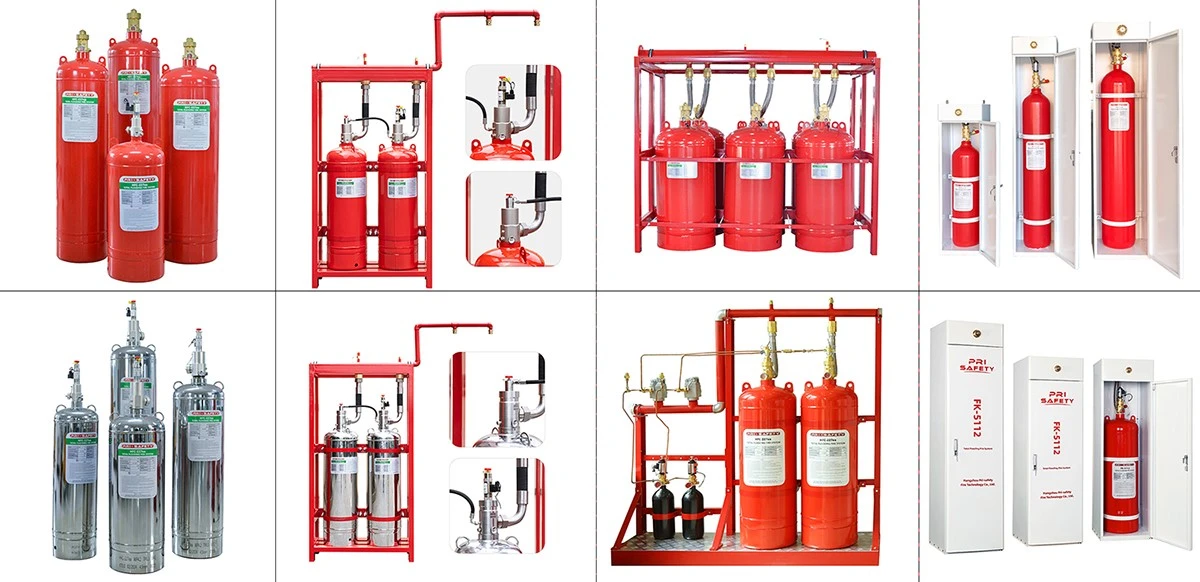
A proper fire suppression comparison Kenya assessment helps businesses select the right extinguishing technology for a specific hazard, occupancy and facility. FM-200, Novec 1230, CO2 and water mist operate differently, so the correct choice depends on fire risk, personnel safety, equipment protection, enclosure conditions, regulatory requirements and lifecycle cost.
This fire suppression comparison Kenya guide examines the engineering differences between clean-agent systems, carbon dioxide suppression and water mist. It is intended for commercial, industrial and institutional facilities in Kenya and the wider East African market.
Related Products
What Is a Fire Suppression Comparison Kenya Assessment?
A fire suppression comparison Kenya assessment is an engineering evaluation of different suppression technologies against a specific fire hazard. It considers extinguishing performance, personnel safety, protected assets, building characteristics, installation requirements, compliance, maintenance and lifecycle cost before a system is selected.
A fire suppression comparison Kenya assessment is particularly important when protecting high-value or business-critical assets.
The four technologies covered in this guide are:
- FM-200
- Novec 1230
- CO2
- Water mist
They should not be treated as interchangeable products.
A clean-agent system designed for an enclosed server room is fundamentally different from a CO2 system protecting specialized industrial equipment. Similarly, a water mist installation requires different engineering considerations from a gaseous suppression system.
The starting point for every fire suppression comparison Kenya project should therefore be the hazard itself.
Why Fire Suppression Comparison Kenya Matters
Fire suppression comparison Kenya is important because selecting an extinguishing agent without understanding the hazard can result in inadequate protection, unnecessary equipment costs or unacceptable personnel risk. Engineering selection must balance fire control, asset protection, occupancy, environmental conditions and operational continuity.
Many facilities initially ask:
Which fire suppression system is cheapest?
That is usually the wrong first question.
The more useful questions are:
- What can burn?
- How quickly can the fire develop?
- Are people normally present?
- Is the room enclosed?
- What equipment needs protection?
- Can water damage the assets?
- Is the hazard electrically energized?
- Are combustible liquids present?
- How quickly must the system respond?
- What happens after discharge?
- Can the system be maintained locally?
These questions make a fire suppression comparison Kenya exercise much more useful than comparing equipment prices alone.
For a professional installation, the suppression system should form part of a wider fire-protection strategy involving detection, alarm, emergency procedures, compartmentation and maintenance.
FM-200 vs Novec 1230 vs CO2 vs Water Mist
FM-200 and Novec 1230 have been used as gaseous clean-agent technologies for sensitive equipment areas. CO2 uses oxygen reduction and can be highly effective for selected industrial hazards but introduces serious life-safety considerations. Water mist uses finely divided water droplets to absorb heat and control combustion.
| Technology | Suppression Medium | Typical Application | Key Advantage | Major Consideration |
|---|---|---|---|---|
| FM-200 | HFC-227ea | Electronic equipment rooms | Rapid gaseous suppression | Environmental requirements |
| Novec 1230 | Fluoroketone agent | Sensitive equipment | Low-residue suppression | Current availability and regulatory status |
| CO2 | Carbon dioxide | Selected industrial hazards | Effective oxygen displacement | Personnel safety |
| Water Mist | Fine water droplets | Machinery and selected industrial risks | Strong cooling effect | Hydraulic/application design |
This table is a preliminary fire suppression comparison Kenya selection matrix rather than a final design specification.
Final selection must follow the applicable standard, manufacturer’s design manual and project-specific hazard assessment.
FM-200 Fire Suppression Systems
FM-200 is a gaseous clean-agent fire suppression technology associated with HFC-227ea. It has been used for enclosed spaces containing sensitive electrical and electronic equipment because it can suppress fires without leaving conventional water or dry-chemical residue.
An FM-200 system may be considered for:
- Server rooms
- Data centres
- Telecommunications rooms
- Control rooms
- Electrical rooms
- Process-control rooms
- Certain archives
The system normally consists of:
- Agent cylinders
- Control panel
- Detection devices
- Distribution pipework
- Discharge nozzles
- Manual controls
- Alarm devices
- Pressure monitoring
- Associated shutdown interfaces
A proper fire suppression comparison Kenya must evaluate the complete system rather than the agent cylinder alone.
How FM-200 Works
FM-200 suppresses fire primarily through heat absorption and interruption of the combustion process. The system is designed to discharge the calculated quantity of agent into a protected enclosure and achieve the required concentration for the specified hazard.
This means room volume is a fundamental design variable.
Engineers must consider:
- Room dimensions
- Ceiling height
- Raised floors
- Ceiling voids
- Openings
- HVAC systems
- Door leakage
- Ventilation
- Pressure relief
An enclosure that cannot retain the required agent concentration may require corrective measures before commissioning.
FM-200 System Design
FM-200 system design requires calculation of agent quantity, distribution pipework, nozzle positioning and discharge characteristics. The design should be based on the applicable standard and manufacturer’s approved calculation methodology rather than a simple cylinder-to-room-size ratio.
A fire suppression comparison Kenya should therefore consider the enclosure as part of the system.
The protected room may require:
- Sealing of unnecessary openings
- HVAC shutdown
- Automatic door closure
- Pressure relief
- Detection zoning
- Pre-discharge warning
- Manual release
- Appropriate emergency procedures
Novec 1230 Fire Suppression Systems
Novec 1230 has historically been used as a clean-agent fire suppression technology for sensitive equipment and enclosed facilities. It was associated with fluoroketone-based extinguishing technology and was designed to suppress fires while minimizing conventional water or powder residue.
Applications historically included:
- Data centres
- Telecommunications facilities
- Electrical rooms
- Control rooms
- Archives
- Museums
- Critical equipment rooms
However, modern specification requires an important additional step.
Before selecting Novec 1230 for a new project, the engineering team should verify:
- Current product availability
- Manufacturer support
- Agent supply
- Replacement-cylinder availability
- Regulatory requirements
- Environmental requirements
- Long-term servicing arrangements
This is an essential part of any fire suppression comparison Kenya exercise.
FM-200 vs Novec 1230
FM-200 vs Novec 1230 should be compared using agent characteristics, required concentration, enclosure requirements, environmental considerations, system availability, maintenance requirements and lifecycle support. Initial equipment price should not be the sole selection criterion.
| Selection Factor | FM-200 | Novec 1230 |
|---|---|---|
| Agent category | HFC | Fluoroketone |
| Conventional water discharge | No | No |
| Residue | No conventional residue | No conventional residue |
| Enclosure integrity | Important | Important |
| Detection system | Required | Required |
| Equipment protection | Strong potential application | Strong potential application |
| New-project availability | Verify | Verify carefully |
| Lifecycle support | Assess locally | Assess carefully |
A current fire suppression comparison Kenya should always verify the status of any proposed agent before procurement.
CO2 Fire Suppression Systems
CO2 fire suppression systems use carbon dioxide to reduce the oxygen concentration around a fire and can provide effective suppression for selected industrial hazards. However, the concentrations required for extinguishment can be dangerous or fatal to people, making life-safety engineering essential.
CO2 may be considered for selected:
- Industrial machinery
- Generator areas
- Engine rooms
- Electrical equipment
- Specialized process equipment
- Enclosed industrial hazards
The suitability must be established through hazard analysis and the applicable design standard.
Why CO2 Requires Special Attention
CO2 presents a significantly different personnel-safety profile from many clean-agent systems. A fire suppression comparison Kenya involving CO2 must therefore give life safety equal or greater priority than equipment protection.
A CO2 system may require:
- Pre-discharge alarms
- Audible warning
- Visual warning
- Time delays
- Manual release controls
- Emergency controls
- Evacuation procedures
- Equipment shutdown
- Ventilation controls
- Appropriate warning signage
The exact system sequence depends on the application.
CO2 in Occupied Areas
CO2 should not be selected for an occupied area simply because it is an effective extinguishing agent. Where hazardous concentrations could expose personnel, the system requires appropriate safeguards, evacuation controls and engineering measures to prevent accidental exposure.
This makes CO2 one of the most important technologies to evaluate carefully during a fire suppression comparison Kenya assessment.
Water Mist Fire Suppression Systems
Water mist systems discharge very small water droplets that provide a large surface area for heat absorption. Depending on the hazard and system design, water mist can cool flames, reduce heat transfer and control fire development while using substantially less water than some conventional water-discharge approaches.
Potential applications include:
- Machinery spaces
- Industrial equipment
- Turbine areas
- Certain electrical hazards
- Commercial facilities
- Specialized process areas
Water mist should never be assumed to be suitable for every fire.
Its effectiveness depends on:
- Droplet characteristics
- Nozzle arrangement
- Discharge pressure
- Flow rate
- Fire type
- Equipment configuration
- Ventilation
- Room geometry
Water Mist vs Clean Agent
Water mist and clean-agent systems solve fire hazards through different mechanisms. Water mist provides cooling using finely divided water, while clean agents are gaseous systems designed for applications where conventional water or powder residue may be undesirable.
A fire suppression comparison Kenya should therefore evaluate the value of cooling versus residue-free suppression.
| Factor | Clean Agent | Water Mist |
|---|---|---|
| Primary medium | Gas | Fine water |
| Conventional water storage | Normally no | Usually required |
| Hydraulic design | No water hydraulics | Required |
| Residue | Generally none | Water |
| Cooling | Moderate/agent dependent | Strong |
| Room integrity | Important for total flooding | Application dependent |
| Electronics | Often suitable | Requires assessment |
| Industrial machinery | Application dependent | Often considered |
| Maintenance | Required | Required |
Fire Suppression Comparison Kenya for Data Centres
Data centres require fire protection that can control fire quickly while minimizing disruption to critical electronic equipment. Clean-agent systems are commonly considered for suitable enclosed spaces because they can suppress fire without conventional water or dry-chemical residue.
A data-centre fire suppression comparison Kenya should examine:
- Server density
- UPS systems
- Battery technology
- Cable loading
- Raised floors
- Ceiling voids
- HVAC configuration
- Room integrity
- Early detection
- Emergency power
- Occupancy
The suppression system should be integrated with the fire alarm and building management systems where appropriate.
Fire Suppression Comparison Kenya for Electrical Rooms
Electrical rooms require suppression strategies that consider energized equipment, electrical fault scenarios, cable insulation and personnel access. The correct system depends on the voltage, equipment configuration, occupancy and fire characteristics.
An electrical-room fire suppression comparison Kenya assessment should consider:
- Switchgear
- Transformers
- UPS systems
- Batteries
- Control panels
- Cable trays
- Electrical loading
- Room ventilation
The selected suppression system must be compatible with the actual hazard.
Fire Suppression Comparison Kenya for Industrial Machinery
Industrial machinery can contain hydraulic oil, lubricants, electrical components and high-temperature surfaces, creating complex fire scenarios. Suppression selection must account for the specific machinery and combustible materials rather than simply the room classification.
Potential technologies include:
- Water mist
- CO2
- Dry chemical
- Specialized local application systems
A fire suppression comparison Kenya for industrial machinery should identify the fire’s likely origin and propagation route.
For example, a fire involving hydraulic fluid may require a different strategy from a fire involving electrical components.
Fire Suppression Comparison Kenya for Commercial Facilities
Commercial facilities have different suppression requirements depending on occupancy, room configuration, equipment and the consequences of fire. Offices, hotels, restaurants, retail facilities and specialized rooms should therefore be assessed individually rather than assigned a single suppression technology.
The assessment may cover:
- Occupancy
- Escape routes
- Kitchen hazards
- Electrical rooms
- Server rooms
- Storage areas
- Plant rooms
- Public access
A complete fire suppression comparison Kenya should also consider how the system affects evacuation and emergency response.
Fire Suppression Comparison Kenya: Cost Analysis
Fire suppression cost depends on technology, protected volume, hazard classification, equipment quantity, detection requirements, pipework, installation complexity, testing, commissioning and maintenance. The cheapest equipment quotation is therefore not necessarily the lowest-cost solution over the system’s operating life.
Lifecycle cost should include:
| Cost Area | What Should Be Considered |
|---|---|
| Engineering | Survey, calculations and design |
| Equipment | Cylinders, valves, nozzles and controls |
| Detection | Detectors, panels and circuits |
| Installation | Pipework, wiring and mounting |
| Testing | Functional and commissioning tests |
| Training | Operator and emergency training |
| Maintenance | Periodic inspection and servicing |
| Spares | Valves, detectors and control components |
| Agent | Future servicing or replacement |
| Modifications | Future expansion or room changes |
A comprehensive fire suppression comparison Kenya should evaluate all of these costs.
Installation and Commissioning Best Practices
Professional installation ensures that the designed fire suppression system operates as intended. Installation should follow approved engineering drawings, manufacturer requirements, applicable standards and project-specific safety procedures, followed by documented testing and commissioning.
Phase 1: Site Survey
The engineering team should establish:
- Protected-room dimensions
- Hazard type
- Equipment arrangement
- Occupancy
- Openings
- HVAC systems
- Electrical supplies
- Access routes
- Existing fire systems
Phase 2: Engineering Design
Fire suppression system design should translate the hazard assessment into agent quantities, pipework, nozzle locations, detection zones and control sequences. Calculations should be completed using the approved methodology for the selected technology.
The design should address:
- Agent quantity
- Pipe sizing
- Nozzle selection
- Detection
- Alarm sequence
- Shutdown interfaces
- Manual release
- Emergency controls
Phase 3: Installation
Installation should verify:
- Correct component selection
- Correct pipe routing
- Appropriate supports
- Correct nozzle orientation
- Detector positioning
- Cylinder mounting
- Control-panel connections
Phase 4: Testing
Testing verifies that the detection, alarm, control and suppression components operate together. Functional testing should be documented and completed before the system is placed into service.
Testing may include:
- Detector testing
- Alarm testing
- Manual release testing
- Control-panel testing
- Interlock testing
- HVAC shutdown
- Equipment shutdown
- Pressure monitoring
- Circuit supervision
Fire Suppression System Commissioning Checklist
A commissioning checklist confirms that the installed system corresponds with the approved design and that critical safety functions operate correctly. It should cover equipment, detection, alarms, controls, interfaces, documentation and personnel training.
| Commissioning Requirement | Status |
|---|---|
| Approved design available | ☐ |
| Hazard assessment completed | ☐ |
| Equipment inspected | ☐ |
| Agent quantity verified | ☐ |
| Cylinders correctly mounted | ☐ |
| Pipework inspected | ☐ |
| Nozzles correctly positioned | ☐ |
| Detectors tested | ☐ |
| Alarm tested | ☐ |
| Manual release tested | ☐ |
| Emergency controls tested | ☐ |
| HVAC interface tested | ☐ |
| Equipment shutdown tested | ☐ |
| Control panel tested | ☐ |
| Warning signage installed | ☐ |
| Room integrity assessed where applicable | ☐ |
| Staff trained | ☐ |
| Test records completed | ☐ |
| Maintenance programme established | ☐ |
Fire Suppression Comparison Kenya and Regulatory Compliance
Fire suppression comparison Kenya projects should consider Kenyan regulatory requirements alongside applicable international fire-protection standards. The project team should verify the requirements applicable to the specific building, occupancy, hazard and installation with the relevant authorities and competent professionals.
Relevant organizations and frameworks can include:
- Energy and Petroleum Regulatory Authority (EPRA), where LPG-related systems are involved
- Kenya Bureau of Standards (KEBS)
- Directorate of Occupational Safety and Health Services (DOSHS)
- National and county fire-safety authorities
- Applicable building and fire-safety requirements
- Manufacturer certifications and listings
- Applicable NFPA standards
NFPA Standards
NFPA standards provide widely recognized technical guidance for fire protection. The specific standard depends on the suppression technology and hazard, so the applicable edition and requirements should be confirmed during project design.
Potentially relevant standards include:
- NFPA 2001 — Clean Agent Fire Extinguishing Systems
- NFPA 72 — National Fire Alarm and Signaling Code
- NFPA 13 — Installation of Sprinkler Systems
- NFPA 750 — Water Mist Fire Protection Systems
For LPG facilities, NFPA 58 may also be relevant to LP-Gas storage and handling, although it is not a general fire-suppression selection standard.
A competent engineer should determine which standards apply to each project.
Fire Detection and Suppression Integration
A suppression system should operate as part of an integrated fire-protection system rather than as an isolated component. Detection, alarm, shutdown, suppression release, emergency procedures and maintenance should be coordinated into a defined sequence of operation.
A typical sequence could involve:
Detection → Alarm → Verification/control logic → HVAC shutdown → Equipment shutdown → Warning period → Suppression release
The exact sequence depends on the hazard and system type.
Megtraco Kenya Ltd also provides fire suppression equipment and control panels for applicable fire-protection applications.
Common Fire Suppression Selection Mistakes
Poor fire suppression selection often results from focusing on the agent rather than the hazard. Common mistakes include ignoring occupancy, failing to evaluate enclosure integrity, overlooking future maintenance and selecting equipment without considering regulatory and manufacturer requirements.
Choosing Based Only on Price
The lowest quotation may not provide the lowest lifecycle cost.
Ignoring Personnel Exposure
This is especially important when considering CO2.
Ignoring Room Integrity
Total-flooding gaseous systems depend on enclosure conditions.
Selecting Obsolete or Difficult-to-Service Technology
Long-term agent and spare-part availability should be evaluated.
Ignoring Detection
Suppression effectiveness depends on timely detection and correctly sequenced release.
Failing to Maintain the System
A neglected system can fail when it is needed.
How to Choose the Right Fire Suppression System
The right fire suppression system is selected by matching the suppression mechanism to the fire hazard, protected assets, occupancy and building conditions. A structured fire suppression comparison Kenya assessment should be completed before equipment procurement or installation.
Use this sequence:
Step 1: Identify the Hazard
Determine what materials can burn.
Step 2: Identify Occupancy
Determine whether people are continuously or occasionally present.
Step 3: Assess Asset Sensitivity
Identify equipment that could be damaged by water, powder or thermal exposure.
Step 4: Evaluate the Building
Assess:
- Room volume
- Openings
- HVAC
- Ventilation
- Access
- Fire compartments
Step 5: Compare Technologies
Evaluate FM-200, Novec 1230, CO2, water mist and other relevant technologies.
Step 6: Check Compliance
Confirm applicable Kenyan and international requirements.
Step 7: Evaluate Lifecycle Cost
Include installation, inspection, servicing and future replacement.
Step 8: Commission Professionally
Document all tests and train facility personnel.
Frequently Asked Questions
How Does Fire Suppression Comparison Kenya Improve Safety?
Fire suppression comparison Kenya improves safety by matching the suppression technology to the actual fire hazard and occupancy. It helps identify risks such as CO2 personnel exposure, inadequate room integrity, incompatible extinguishing media and unsuitable system configurations before installation.
What Is the Difference Between FM-200 and Novec 1230?
FM-200 and Novec 1230 are different clean-agent technologies. Both have been used in sensitive equipment environments, but they differ in chemical composition, system characteristics, environmental considerations and current product availability. A current engineering assessment should be completed before specification.
Is CO2 Suitable for Occupied Areas?
CO2 can create dangerous concentrations for people and therefore requires rigorous life-safety controls. A CO2 system should only be selected after evaluating occupancy, evacuation, alarms, time delays and applicable safety requirements for the specific hazard.
Is Water Mist Better Than Clean Agent?
Neither technology is universally better. Water mist provides strong cooling using finely divided water, while clean agents can be advantageous where conventional water or powder residue is undesirable. The correct selection depends on the hazard and protected assets.
What Is the Best Fire Suppression System for a Data Centre?
Clean-agent systems can be suitable for many enclosed data-centre environments because they can suppress fire without conventional water or powder residue. The final system must be engineered around the room, equipment, detection, agent concentration, occupancy and applicable standards.
How Much Does Fire Suppression Cost in Kenya?
There is no universal price for fire suppression systems Kenya because project costs depend on hazard, room volume, technology, equipment, detection, installation, pipework, commissioning and maintenance requirements. A site assessment is normally required for an accurate quotation.
How Often Should a Fire Suppression System Be Inspected?
Inspection and maintenance frequency depends on the suppression technology, manufacturer requirements, applicable standards and site risk. Critical systems should have a documented inspection and maintenance programme carried out by competent personnel.
What Should Be Considered Before Installing a Fire Suppression System?
A fire suppression comparison Kenya assessment should consider fire type, occupancy, protected assets, room configuration, detection, agent compatibility, regulatory requirements, installation complexity, maintenance and lifecycle cost before procurement.
Engineering Conclusion
A professional fire suppression comparison Kenya assessment is the foundation for selecting an effective and safe suppression technology. FM-200, Novec 1230, CO2 and water mist each have different engineering characteristics, and none should be treated as a universal solution.
The correct system should be based on:
- Fire hazard
- Occupancy
- Asset value
- Equipment sensitivity
- Room configuration
- Detection requirements
- Personnel safety
- Applicable standards
- Installation requirements
- Maintenance
- Lifecycle cost
- Long-term equipment availability
For sensitive electronic equipment, clean-agent technology may provide an appropriate approach where properly engineered.
For selected industrial hazards, CO2 can provide effective suppression but requires stringent life-safety measures.
For suitable machinery and industrial applications, water mist can provide strong heat absorption and fire-control capability.
The objective of fire suppression comparison Kenya is therefore not to identify one universally superior agent. The objective is to identify the right engineered system for the specific hazard.
Megtraco Kenya Ltd can support businesses with fire-protection equipment and engineering solutions for commercial, industrial and institutional applications. Facilities requiring a detailed fire suppression comparison Kenya assessment should begin with a professional site and hazard evaluation rather than equipment selection based solely on price.
Your Trusted LPG & Fire Safety Engineering Partner in East Africa
Whether you’re designing a new LPG installation, upgrading industrial gas systems, or enhancing fire safety compliance, Megtraco Kenya Ltd delivers certified engineering solutions backed by decades of expertise. From LPG equipment supply and pipeline installations to fire suppression and detection systems, our experienced team provides reliable solutions for commercial, industrial, and institutional projects across East Africa.
Contact us today for professional consultation, engineering support, or a customized quotation.
WHY CHOOSE MEGTRACO KENYA LTD
- ✔ Established Since 1969 – Decades of proven engineering excellence.
- ✔ KEBS Certified Products – Guaranteed quality and compliance with regional standards.
- ✔ EPRA Licensed LPG Engineering Company – Fully certified to design, install, and commission.
- ✔ Industrial & Commercial LPG Specialists – Scaled to handle heavy-duty thermal requirements.
- ✔ Fire Suppression & Fire Detection Experts – End-to-end asset protection.
- ✔ Regional Operational Footprint – Serving Nairobi, Mombasa, Kisumu, Nakuru, Eldoret, Thika, Machakos, East Africa, and beyond.
Contact Megtraco Kenya Ltd
- Email: sales@megtracokenya.com
- Sales: +254 725 870 114
- Technical: +254 733 721 598
- WhatsApp: +254 799 086 323
- Location: Nairobi, Kenya – Serving East Africa
- Website: https://megtracokenya.com
Request a Quote today and partner with East Africa’s trusted LPG and fire safety engineering company since 1969.
