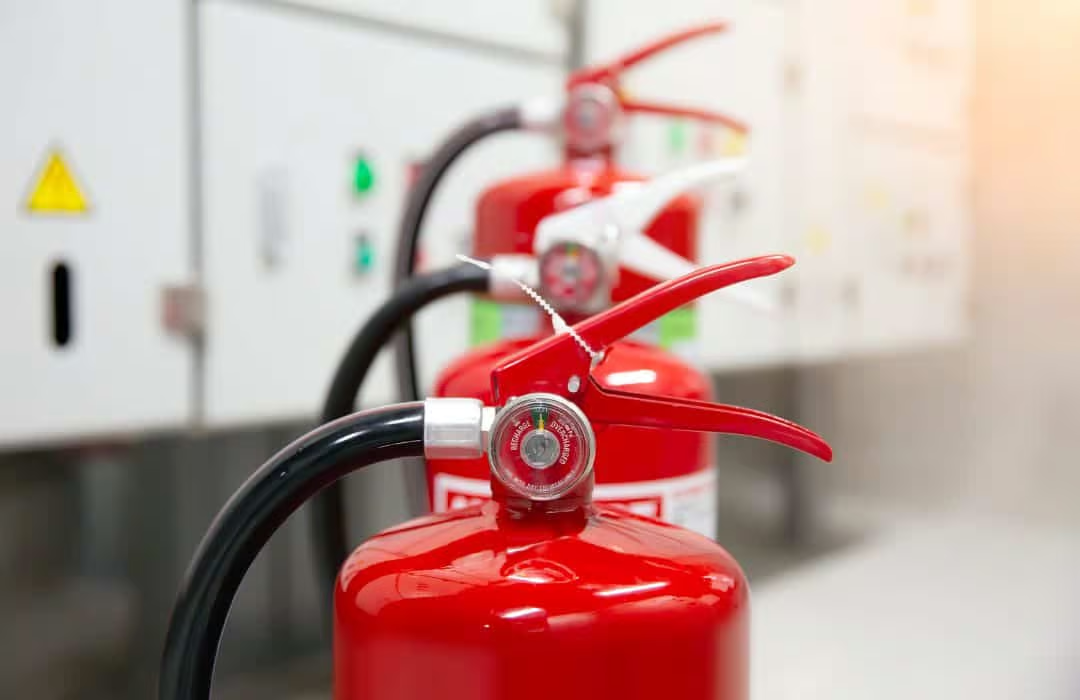
Fire system servicing Kenya is the structured inspection, testing, maintenance and documentation of fire protection equipment to ensure that systems remain available and functional when required. For workplaces, the Kenyan Fire Risk Reduction Rules require firefighting appliances to be inspected and tested by a competent person at least once every 12 months, while records and fire safety audit reports must be maintained.
Fire protection equipment is only useful if it works when a fire occurs.
Related Products

An extinguisher with inadequate pressure, a blocked hose reel, a fire alarm with disabled detectors, a suppression system with a fault or an emergency exit blocked by stored materials can turn an apparently compliant workplace into a serious operational and life-safety risk.
That is why fire system servicing Kenya should be treated as an ongoing engineering and compliance activity rather than an occasional visit to place a service sticker on an extinguisher.
The Kenyan regulatory framework places responsibilities on workplace occupiers to maintain suitable means of extinguishing fire, keep escape routes available and ensure that firefighting equipment is properly maintained. The Occupational Safety and Health Act also requires appropriate firefighting means to be provided and maintained and kept accessible.
The Directorate of Occupational Safety and Health Services (DOSHS) enforces the Occupational Safety and Health Act and subsidiary legislation including the Factories and Other Places of Work (Fire Risk Reduction) Rules.
For businesses operating offices, factories, warehouses, hotels, hospitals, schools, commercial kitchens, LPG installations and industrial facilities, fire system servicing Kenya should therefore combine regulatory compliance with actual system performance.
What Does Fire System Servicing Kenya Involve?
Fire system servicing Kenya involves inspecting, testing, maintaining and documenting fire protection equipment so that defects are identified and corrected before an emergency occurs. It can cover extinguishers, fire alarms, hose reels, hydrants, suppression systems, emergency lighting and associated controls.
Servicing is broader than simply cleaning equipment.
Depending on the system, professional fire system servicing Kenya can include:
- Visual inspection
- Functional testing
- Pressure checks
- Electrical testing
- Battery testing
- Alarm testing
- Detector testing
- Hose-reel testing
- Hydrant testing
- Suppression-system inspection
- Cylinder inspection
- Pipework inspection
- Valve inspection
- Nozzle inspection
- Flow testing
- Record verification
- Defect identification
- Corrective maintenance
- Replacement of defective components
The exact maintenance procedure depends on the equipment type, applicable standard, manufacturer requirements and risk profile.
Kenya has gazetted standards covering portable extinguishers, extinguisher inspection and maintenance, fire detection and alarm systems, hose reels, hydrant systems, gaseous extinguishing systems and other fire-protection equipment.
Why Fire System Servicing Kenya Is a Compliance Requirement
Fire system servicing Kenya is not simply an optional maintenance programme. Kenyan workplace requirements place responsibility on occupiers to maintain firefighting equipment, arrange inspection and testing by competent persons and retain records of those activities.
The Fire Risk Reduction Rules require all means of extinguishing fire to be properly maintained.
They also require the occupier to arrange inspection and testing of firefighting appliances by a competent person at least once every twelve months and to keep records showing the inspection and test date and the person who performed the work. The same rules require cylinders used for firefighting appliances to undergo examination and testing at least once every five years, including hydraulic pressure testing, subject to the applicable requirements.
This makes documentation a fundamental part of fire system servicing Kenya.
A business should therefore be able to demonstrate:
- What equipment it has
- Where the equipment is located
- When it was inspected
- Who inspected it
- What was found
- What defects existed
- What corrective action was taken
- When the next service is due
Fire System Servicing Kenya: Inspection vs Testing vs Maintenance
Inspection, testing and maintenance are related but different activities. Inspection identifies condition or defects, testing determines whether a system performs its intended function, and maintenance restores or preserves equipment performance. Effective fire system servicing Kenya should clearly document all three.
Inspection
Inspection examines the physical condition of equipment.
Examples include:
- Extinguisher condition
- Pressure gauge condition
- Hose condition
- Detector condition
- Valve position
- Access
- Signage
Testing
Testing evaluates functionality.
Examples include:
- Fire alarm activation
- Pump operation
- Hose-reel flow
- Hydrant pressure
- Emergency-light operation
- Detection-device activation
Maintenance
Maintenance addresses deficiencies.
Examples include:
- Recharging extinguishers
- Replacing hoses
- Replacing batteries
- Cleaning detectors
- Repairing valves
- Replacing damaged components
- Correcting pipework defects
A professional fire system servicing Kenya programme should distinguish these activities rather than recording everything as a generic “service.”
How Often Should Fire Systems Be Serviced in Kenya?
The Kenyan Fire Risk Reduction Rules establish an annual minimum for inspection and testing of workplace firefighting appliances by a competent person, while specific systems can require more frequent inspections or maintenance based on their applicable standards, manufacturer instructions, risk profile and service contract.
This distinction is important.
The annual requirement should not be interpreted as meaning that every fire system only needs attention once per year.
For example, a large commercial facility may implement:
- Daily or weekly visual checks
- Monthly inspections
- Quarterly servicing
- Annual professional inspection
- Periodic specialist testing
The appropriate frequency depends on the system.
Some procurement specifications in Kenya, for example, require quarterly inspection or servicing of firefighting equipment and alarm systems, illustrating why a facility’s contract or system-specific maintenance programme may exceed the statutory annual minimum.
Therefore, fire system servicing Kenya should use the annual legal requirement as a baseline rather than automatically treating 12 months as the correct interval for every component.
Fire Extinguisher Service Interval
The fire extinguisher service interval depends on the applicable Kenyan requirements, extinguisher standard, manufacturer instructions, operating environment and condition of the cylinder. Workplace firefighting appliances must undergo inspection and testing by a competent person at least annually under the Fire Risk Reduction Rules.
The service process should assess:
- Cylinder condition
- Corrosion
- Pressure
- Safety pin
- Tamper seal
- Hose
- Nozzle
- Operating instructions
- Mounting
- Accessibility
- Correct extinguisher type
- Discharge condition
- Previous service history
The Kenyan standards framework includes KS ISO/TS 11602-2 for inspection and maintenance of portable and wheeled fire extinguishers.
The 2024 National Building Code also references KS ISO/TS 11602-1 and KS ISO/TS 11602-2 for selection, installation, inspection and maintenance of portable fire extinguishers.
A professional fire system servicing Kenya inspection should therefore verify both the physical condition and the documentation associated with each extinguisher.
What Inspectors Check on Fire Extinguishers
Inspectors and competent service personnel look beyond the presence of an extinguisher. They can assess accessibility, location, condition, suitability, pressure indication, signage, mounting and service history to determine whether the equipment is actually ready for use.
Typical checks include:
Location
Is the extinguisher positioned where it can be reached quickly?
Accessibility
Is furniture, stock or machinery blocking it?
Identification
Is the extinguisher clearly identifiable?
Mounting
Is it securely mounted or appropriately positioned?
Instructions
Are operating instructions visible and legible?
Physical condition
Is the cylinder damaged or corroded?
Pressure
Where a pressure indicator is provided, is it within the appropriate operating range?
Components
Are the hose, nozzle, pin and seal intact?
Suitability
Is the extinguisher appropriate for the hazard?
Records
Is there evidence of previous servicing?
The Fire Risk Reduction Rules also address the accessibility and mounting of portable extinguishers in workplaces.
Fire System Servicing Kenya for Fire Alarm Systems
Fire alarm servicing involves testing the control panel, detectors, manual call points, sounders, visual indicators, batteries, interfaces and fault monitoring. Fire system servicing Kenya should verify not only that individual devices operate but that the complete alarm sequence performs correctly.
A professional fire alarm inspection may include:
- Control panel inspection
- Detector testing
- Manual call-point testing
- Sounder testing
- Strobe testing
- Battery inspection
- Charger testing
- Fault monitoring
- Zone verification
- Input/output testing
- Door-release interfaces
- HVAC interfaces
- Fire suppression interfaces
Kenya’s standards framework includes KS ISO 7240 standards covering fire detection and alarm systems, including design, installation, commissioning and service.
A fire alarm system that displays a normal status on its panel is not automatically proof that every detector and alarm device will perform correctly.
Testing remains necessary.
Fire System Servicing Kenya for Fire Suppression Systems
Fire suppression systems require specialized inspection because their effectiveness depends on the condition of detection devices, control panels, cylinders, valves, pipework, nozzles, release mechanisms and protected spaces. Fire system servicing Kenya should therefore be performed by personnel competent in the specific suppression technology installed.
Systems can include:
- Clean-agent systems
- CO2 systems
- Dry-chemical systems
- Wet-chemical kitchen systems
- Water-mist systems
- Foam systems
- Automatic sprinkler systems
The service requirements are not identical.
For a clean-agent system, for example, inspection may include:
- Cylinder pressure
- Cylinder weight where applicable
- Valve condition
- Pipework
- Nozzles
- Detection
- Releasing panel
- Manual release
- Abort control
- HVAC interfaces
- Room integrity
- Pressure-relief provisions
For a wet-chemical kitchen system, inspection will focus on:
- Agent container
- Detection links
- Fusible elements
- Nozzles
- Pipework
- Manual release
- Fuel/gas shutoff
- Hood configuration
This is why generic fire system servicing Kenya should be avoided where specialist suppression equipment is installed.
Fire Hose Reel Servicing
Fire hose reels need regular inspection to ensure that they remain accessible, mechanically sound and capable of delivering water when required. Fire system servicing Kenya should assess the hose, reel assembly, valve, nozzle, cabinet, signage and water supply, with functional testing performed according to the applicable requirements.
Inspectors may check:
- Reel accessibility
- Hose condition
- Nozzle condition
- Valve operation
- Cabinet condition
- Leakage
- Signage
- Water flow
- Mounting
- Obstructions
Kenya’s standards catalogue includes KS 2003 for hose reels and KS 1960-1:2015 for maintenance of fire-protection equipment relating to fire hose reels.
A hose reel that cannot be reached quickly is a practical safety failure even if the equipment itself is technically intact.
Fire Hydrant System Maintenance
Hydrant systems require inspection of valves, hose connections, hydrant outlets, accessibility and associated components, while larger installations may also require flow and pressure testing. Fire system servicing Kenya should evaluate the complete water-delivery system rather than inspecting only visible hydrant cabinets.
A hydrant inspection may include:
- Hydrant location
- Accessibility
- Valve condition
- Couplings
- Caps
- Hose equipment
- Cabinet condition
- Water supply
- Pressure
- Flow
- Pump operation where applicable
Kenya’s standards framework includes KS 2175:2015 for components of underground and aboveground hydrant systems.
Fire Pump Inspection and Testing
Fire pumps are critical to water-based suppression systems because their failure can prevent sprinklers, hydrants or hose reels from receiving the required water supply. Fire system servicing Kenya for pump installations should therefore include mechanical, electrical, control and performance checks appropriate to the system.
Checks can include:
- Pump condition
- Controller status
- Power supply
- Diesel fuel where applicable
- Battery condition
- Starting sequence
- Pressure
- Flow
- Valves
- Jockey pump
- Automatic starting
- Alarm signals
A pump should not be considered healthy merely because it starts during a quick visual inspection.
Performance testing provides more useful information.
Emergency Lighting and Exit Sign Inspection
Emergency lighting and exit signs help occupants evacuate when normal lighting fails. Fire system servicing Kenya should therefore consider emergency lighting and escape-route equipment as part of the wider fire-safety inspection programme, even though these systems have different technical maintenance requirements from extinguishing equipment.
Inspect:
- Luminaire condition
- Battery condition
- Charging
- Automatic changeover
- Illumination
- Exit signs
- Escape-route visibility
- Obstructions
The objective is to confirm that occupants can identify and follow the escape route during an emergency.
What Fire Inspectors Actually Look For
A fire inspection is not simply an equipment-counting exercise. Inspectors can assess whether the workplace has suitable firefighting equipment, whether it is maintained and accessible, whether escape routes are available, whether workers have appropriate fire-safety arrangements and whether supporting records demonstrate that required inspections and audits have been completed.
DOSHS officially lists workplace inspections and fire safety audits among its services, with fire safety audits conducted by approved fire safety auditors.
Inspectors may therefore look at:
- Fire extinguishers
- Fire alarm systems
- Hose reels
- Hydrants
- Fire pumps
- Emergency exits
- Escape routes
- Fire doors
- Emergency lighting
- Fire signage
- Fire assembly points
- Staff training
- Fire drills
- Maintenance records
- Fire safety audit reports
- Risk assessments
- Corrective actions
A strong fire system servicing Kenya programme prepares the facility for this broader assessment.
Fire Records Inspection
Fire records inspection verifies that the business can demonstrate its fire-safety activities through dated, traceable documentation. A service sticker alone is not a complete maintenance record; businesses should retain inspection reports, test results, defect reports, corrective actions and relevant certificates.
Useful records include:
| Record | Purpose |
|---|---|
| Equipment register | Identifies all fire equipment |
| Service reports | Shows maintenance performed |
| Inspection reports | Documents condition |
| Test results | Demonstrates functionality |
| Defect reports | Identifies failures |
| Corrective-action records | Shows defects were addressed |
| Fire drill records | Demonstrates emergency preparedness |
| Training records | Shows staff training |
| Fire audit report | Demonstrates periodic fire-safety audit |
| Certificates | Supports compliance documentation |
| Asset photographs | Provides visual evidence |
| Contractor details | Establishes service accountability |
The Occupational Safety and Health Act provides for preservation of registers and records for at least three years, unless a different period is prescribed for a particular class of record.
Fire System Servicing Kenya Documentation Checklist
Good documentation should allow an inspector, facilities manager or auditor to trace the history of each important fire-protection asset. Fire system servicing Kenya records should show what was inspected, when it was inspected, who performed the work, what was found and what action followed.
A practical documentation file should contain:
- Equipment inventory
- Asset identification numbers
- Previous service dates
- Current service dates
- Service personnel details
- Defect reports
- Repair records
- Replacement records
- Test certificates
- Fire alarm reports
- Fire pump test reports
- Hose-reel reports
- Hydrant reports
- Suppression-system reports
- Fire drill records
- Staff training records
- Fire safety audit reports
- Risk assessment documents
Digital records can be useful, but they should remain accessible and traceable.
Fire System Servicing Kenya Inspection Matrix
A maintenance matrix helps facilities managers avoid relying on memory for recurring fire-safety tasks. The exact frequency should be determined from Kenyan requirements, applicable standards, manufacturer instructions, risk assessment and the system’s maintenance programme.
| Equipment | Routine Facility Check | Professional Inspection/Testing | Records |
|---|---|---|---|
| Fire extinguishers | Visual condition/access | At least annual workplace inspection/testing baseline | Service report |
| Fire alarm | Panel status | System-specific scheduled testing | Alarm report |
| Hose reels | Accessibility/condition | Functional testing | Test report |
| Hydrants | Accessibility/condition | Flow/pressure testing as applicable | Test report |
| Fire pumps | Status/visual checks | Performance testing | Pump report |
| Clean-agent system | Panel/cylinder condition | Specialist inspection | Suppression report |
| Wet-chemical system | Visual condition | Specialist servicing | Kitchen system report |
| Emergency lighting | Functional indication | Formal testing | Test record |
| Exit signage | Visibility | Functional assessment | Inspection record |
Important: The table is a planning framework, not a replacement for the applicable standard or manufacturer’s maintenance instructions.
Competent Persons and Fire System Servicing Kenya
Fire equipment should be inspected, tested and serviced by appropriately competent personnel for the system involved. Specialist systems require specialist knowledge because incorrect maintenance can disable the system or create a false sense of security.
Competence should match the equipment.
For example:
- Portable extinguishers require extinguisher servicing competence.
- Fire alarms require fire alarm system competence.
- Suppression systems require system-specific competence.
- Fire pumps require mechanical and electrical competence.
- Hydrants require water-based fire-system competence.
DOSHS maintains processes concerning approved persons and institutions and identifies fire safety audits as a specialized function carried out by approved fire safety auditors.
A business should therefore ask a service provider:
- Who will perform the inspection?
- What qualifications do they hold?
- Are they competent for this system?
- What standard are they using?
- Will they provide a written report?
- How are defects classified?
- How are corrective actions tracked?
Fire System Servicing Kenya and KEBS Standards
Kenyan fire-protection work should reference the applicable current Kenyan standards and approved equipment requirements. KEBS maintains the national standards framework, while its fire-fighting and fire-protection technical committee covers standardization of fire-protection and firefighting apparatus and equipment.
The Kenyan standards catalogue includes, among others:
- KS ISO/TS 11602-1 — extinguisher selection and installation
- KS ISO/TS 11602-2 — extinguisher inspection and maintenance
- KS ISO 7240 series — fire detection and alarm systems
- KS ISO 14520-1 — gaseous fire-extinguishing systems
- KS 2003 — fire hose reels
- KS 1960-1 — fire hose-reel maintenance
- KS 2175 — hydrant-system components
These standards are part of the technical foundation for professional fire system servicing Kenya.
KEBS also advises users of Kenyan Standards to ensure they are implementing the latest versions because standards are subject to review.
Fire Safety Audits in Kenya
A fire safety audit is broader than routine equipment servicing. It evaluates the workplace’s overall fire-safety arrangements, including equipment, escape routes, procedures, training and other relevant risk controls. Fire system servicing Kenya should therefore support, rather than replace, the workplace fire safety audit.
The Fire Risk Reduction Rules provide for a fire safety audit of the workplace at least once every twelve months by an approved fire auditor and require the occupier to keep the audit report.
DOSHS also identifies fire safety audits as a workplace-audit service carried out by approved fire safety auditors.
This means an annual service report and an annual fire safety audit are not necessarily the same document.
Fire System Servicing Kenya for Offices
Office fire protection depends on appropriate extinguishers, alarm systems, escape routes, emergency lighting, signage and trained personnel. Fire system servicing Kenya for offices should focus on accessibility, equipment condition, alarm functionality and the ability of employees to evacuate safely.
Common office problems include:
- Blocked extinguishers
- Missing signage
- Expired service records
- Disabled detectors
- Obstructed exits
- Dead emergency-light batteries
- Untrained staff
- Stored materials in escape routes
These problems can often be corrected before an inspection.
Fire System Servicing Kenya for Warehouses
Warehouses can present greater fire loads because of stored goods, packaging, pallets, chemicals or combustible materials. Fire system servicing Kenya for warehouses should therefore consider equipment accessibility, storage arrangement, sprinkler or hydrant systems, extinguishers, detection and changes to the stored commodities.
Servicing should verify that:
- Fire points remain accessible
- Extinguisher types match hazards
- Hose reels remain unobstructed
- Sprinkler heads are not blocked
- Hydrants remain accessible
- Fire exits remain clear
- Storage does not compromise fire separation
Changes in warehouse inventory can change the fire risk.
Fire System Servicing Kenya for Hotels
Hotels require fire protection that considers sleeping occupants, kitchens, electrical rooms, laundry areas, plant rooms and public spaces. Fire system servicing Kenya for hospitality facilities should therefore cover multiple interconnected systems and ensure that staff understand emergency procedures.
A hotel may require:
- Portable extinguishers
- Fire alarm
- Hose reels
- Hydrants
- Kitchen suppression
- Emergency lighting
- Exit signage
- Fire doors
- Fire pumps
- Staff fire training
The maintenance programme should be coordinated across all systems.
Fire System Servicing Kenya for Hospitals
Hospitals require careful fire-system maintenance because evacuation can be complicated by patients with limited mobility, medical equipment and critical services. Fire system servicing Kenya for hospitals should prioritize reliable detection, alarm notification, compartmentation, escape routes and appropriate suppression systems.
Special attention should be given to:
- Critical care areas
- Electrical rooms
- Generator rooms
- Oxygen-related areas
- Kitchens
- Laboratories
- Pharmacies
- Data rooms
Maintenance should be coordinated with hospital operations to avoid unnecessary disruption.
Fire System Servicing Kenya for Industrial Facilities
Industrial facilities often contain multiple fire hazards and specialized systems, making systematic maintenance essential. Fire system servicing Kenya for industrial sites may involve extinguishers, hydrants, pumps, sprinklers, foam systems, gas detection, fire alarms and specialized suppression systems.
The maintenance programme should account for:
- Production processes
- Flammable materials
- LPG
- Solvents
- Electrical systems
- Boilers
- Storage
- Process equipment
Industrial servicing should be based on risk rather than a generic checklist.
What Happens When a Defect Is Found?
A defect should be documented, assessed for severity and corrected within an appropriate timeframe. Critical defects affecting immediate fire protection should not simply be recorded and ignored; temporary controls or equipment replacement may be necessary until permanent corrective action is completed.
A useful defect classification is:
Critical
The system cannot perform its essential safety function.
Example:
- Fire pump unavailable
- Suppression cylinder discharged
- Fire alarm disabled
- Main control panel failed
Major
Performance is significantly compromised.
Example:
- Multiple detectors faulty
- Hose reel leaking
- Several extinguishers inaccessible
Minor
The issue does not immediately prevent system operation but should be corrected.
Example:
- Damaged signage
- Minor cabinet defect
- Documentation gap
The classification should be based on the actual risk.
Fire System Servicing Kenya Corrective-Action Process
A professional corrective-action process closes the loop between inspection and maintenance. Fire system servicing Kenya should not end when a defect is written on a report; the facility should track the defect until repair, replacement, retesting and closure are documented.
Recommended process:
Inspect → Record → Classify → Correct → Retest → Close
For each defect record:
- Asset ID
- Location
- Defect description
- Severity
- Recommended action
- Responsible person
- Target date
- Completion date
- Retest result
- Closure confirmation
This creates an auditable maintenance trail.
Common Fire Servicing Mistakes
The most common servicing failures are usually procedural rather than technological. Businesses may have sufficient fire equipment but still fail because equipment is inaccessible, records are incomplete, defects remain unresolved or systems are not tested properly.
Mistake 1: Servicing Only Before Inspection
Fire protection should be maintained continuously.
Mistake 2: Relying on Stickers
A sticker does not demonstrate the complete inspection process.
Mistake 3: Ignoring Defects
A defect report without corrective action does not restore protection.
Mistake 4: Using One Generic Checklist
Different systems require different tests.
Mistake 5: Ignoring Manufacturer Instructions
Manufacturer maintenance requirements can be more specific than a generic inspection.
Mistake 6: Failing to Track Assets
Without equipment identification, service history becomes difficult to verify.
Mistake 7: Forgetting Building Changes
New walls, equipment, storage arrangements and partitions can change fire risk.
Fire System Servicing Kenya: Practical Annual Compliance File
A well-organized annual fire-safety file gives management and inspectors a clear picture of the site’s fire-protection status. Fire system servicing Kenya records should be organized by system, date and asset so that evidence can be retrieved quickly.
A practical file can include:
- Fire equipment inventory
- Current floor plan
- Fire-point locations
- Extinguisher service records
- Alarm test reports
- Hose-reel reports
- Hydrant reports
- Fire-pump reports
- Suppression-system reports
- Emergency-light test records
- Fire-drill reports
- Staff training records
- Fire safety audit
- Risk assessment
- Defect register
- Corrective-action register
- Certificates
- Contractor details
- Previous inspection reports
- Current maintenance schedule
The Occupational Safety and Health Act requires relevant registers and records to be preserved and available for inspection for at least three years, unless another period is prescribed.
How to Prepare for a Fire Safety Inspection
Preparation should focus on actual fire readiness rather than simply making paperwork look complete. Before an inspection, management should verify that equipment is accessible, systems are functional, escape routes are clear and required records are available.
Use this pre-inspection checklist:
| Inspection Area | Question |
|---|---|
| Extinguishers | Are all units accessible and suitable? |
| Fire alarm | Is the panel normal and fully functional? |
| Hose reels | Are they accessible and operational? |
| Hydrants | Are outlets accessible? |
| Fire pump | Is the pump operational? |
| Emergency exits | Are escape routes clear? |
| Emergency lighting | Does it function? |
| Signage | Are fire points clearly marked? |
| Records | Are current reports available? |
| Training | Have employees received fire-safety training? |
| Drills | Are drill records available? |
| Audit | Is the current fire safety audit report available? |
| Defects | Have previous findings been closed? |
DOSHS states that workplace fire-safety training supports formation of a firefighting team and is normally accompanied by a fire drill.
Fire System Servicing Kenya and Staff Training
Equipment maintenance is only one part of fire preparedness. Employees should understand alarm procedures, evacuation routes, assembly points and, where appropriately trained, the safe use of firefighting equipment. Fire system servicing Kenya should therefore be integrated with training and emergency planning.
Training should cover:
- Alarm activation
- Evacuation
- Assembly points
- Emergency communication
- Fire extinguisher awareness
- Fire warden duties
- Reporting procedures
- Fire drill participation
Employees should never be encouraged to fight a fire when evacuation is the safer response.
Fire System Servicing Kenya for LPG Facilities
LPG facilities require specialized fire protection because LPG is highly flammable and can produce a rapidly developing fire if released and ignited. Fire system servicing Kenya for LPG installations should consider detection, emergency shutdown, extinguishers, hydrants, fire pumps, suppression systems and the condition of the gas installation itself.
Depending on the facility, maintenance may include:
- LPG leak detection
- Emergency shutdown
- Gas detection alarms
- Fire extinguishers
- Hydrant systems
- Fire pumps
- Water spray
- Control panels
- Emergency signage
Fire protection should be coordinated with LPG engineering and operational procedures.
Professional Fire System Servicing Kenya
Professional servicing provides more than a routine visual check. A competent technical team can identify defects, perform appropriate functional tests, document findings and recommend corrective action based on the installed system and applicable requirements.
Megtraco Kenya Ltd provides fire suppression equipment for commercial and industrial applications.
Facilities requiring integrated fire engineering can also explore professional engineering consultation for system-specific requirements.
For facilities using gas-related fire-risk controls, industrial gas leak detection can form part of a broader safety strategy.
Frequently Asked Questions
How Often Should Fire Systems Be Serviced in Kenya?
The Fire Risk Reduction Rules establish at least annual inspection and testing of workplace firefighting appliances by a competent person. Individual systems can require more frequent maintenance based on applicable standards, manufacturer instructions, risk assessment and the facility’s maintenance programme.
What Is the Fire Extinguisher Service Interval?
For workplace compliance, firefighting appliances must be inspected and tested by a competent person at least once every 12 months under the Fire Risk Reduction Rules. Specific inspection and maintenance requirements should also follow the applicable Kenyan standard and manufacturer instructions.
What Records Do Fire Inspectors Check?
Inspectors may require evidence that firefighting equipment has been inspected and maintained, together with fire-safety audit reports and other relevant workplace records. Service reports, test certificates, defect records, corrective-action reports, training records and drill records are useful evidence.
Is an Annual Service Sticker Enough?
No. A sticker identifies a service date but does not replace a detailed inspection or test record. A professional fire system servicing Kenya report should identify the equipment, work performed, findings, defects, recommendations and service personnel.
How Long Should Fire Safety Records Be Kept?
The Occupational Safety and Health Act states that relevant registers and records must generally be preserved and available for inspection for at least three years, unless another period is prescribed. Businesses should also retain system-specific records for the practical life of the equipment where appropriate.
What Is the Difference Between Servicing and a Fire Safety Audit?
Servicing focuses on maintaining and testing particular fire-protection equipment, while a fire safety audit examines the broader fire-safety arrangements of a workplace. They support each other but are not interchangeable.
Who Can Service Fire Protection Equipment?
Fire equipment should be serviced by competent personnel with appropriate knowledge and capability for the specific equipment. Specialist systems such as gaseous suppression, fire alarms and fire pumps require system-specific technical competence.
What Happens If an Extinguisher Is Damaged?
A damaged extinguisher should be assessed by competent personnel and removed from service or repaired/replaced as appropriate. Corrosion, mechanical damage and other conditions can affect cylinder safety and reliability.
Should Fire Alarm Systems Be Serviced Annually?
The appropriate interval depends on the applicable Kenyan standard, system design, manufacturer requirements and risk assessment. Annual professional servicing may form part of a broader programme containing more frequent routine checks and functional tests.
What Does Fire System Servicing Kenya Cost?
Cost depends on the number and type of systems, equipment quantity, site size, testing requirements, defects, replacement components and specialist systems. A proper quotation should follow an equipment inventory or site assessment rather than relying only on building floor area.
What Should a Fire Equipment Service Report Contain?
A good report should identify the equipment, location, inspection date, inspection activities, condition, defects, corrective recommendations, service personnel and next required action. More complex systems should have detailed test results and system-specific documentation.
Is Fire System Servicing Kenya Required for Small Offices?
Small offices are still workplaces and must maintain appropriate means of fire protection and safe escape arrangements. The scale of equipment depends on the building, occupancy and hazards, but maintenance and accessibility remain essential.
What Is the Role of DOSHS?
DOSHS enforces the Occupational Safety and Health Act and subsidiary legislation including the Fire Risk Reduction Rules. It also provides workplace inspection and fire-safety audit functions.
What Role Does KEBS Play?
KEBS develops and maintains Kenya Standards relevant to fire-protection equipment and systems. Applicable standards should be identified for the equipment being serviced, and users should verify that they are working with current standards.
Engineering Conclusion
Effective fire system servicing Kenya is a continuous process of inspection, testing, maintenance, documentation and corrective action. The objective is not simply to satisfy an inspection date but to ensure that extinguishers, alarms, suppression systems, hose reels, hydrants, pumps and related safety systems remain capable of performing their intended function.
For workplace operators, the practical priorities are straightforward:
- Maintain an accurate fire-equipment inventory.
- Conduct routine visual checks.
- Arrange competent professional inspection and testing.
- Follow applicable Kenyan standards.
- Follow manufacturer maintenance requirements.
- Keep detailed records.
- Correct defects promptly.
- Maintain clear escape routes.
- Train employees.
- Conduct required fire safety audits.
- Keep documentation available for inspection.
- Review the fire strategy whenever the workplace changes.
The Kenyan legal framework establishes important minimum obligations, but a sophisticated commercial or industrial maintenance programme should go beyond minimum compliance where the risk demands it.
A warehouse with high combustible loading, a hospital with vulnerable occupants, a hotel with sleeping guests, an LPG installation or a data centre with mission-critical equipment cannot reasonably be managed using the same maintenance approach as a small low-risk office.
That is why fire system servicing Kenya should be risk-based and system-specific.
Megtraco Kenya Ltd can support organizations with fire-protection equipment, technical systems and engineering guidance for commercial, industrial and institutional applications.
For businesses reviewing their current maintenance programme, the next step should be an equipment inventory, condition assessment and documented maintenance plan.
Professional fire system servicing Kenya helps transform fire protection from a compliance exercise into a functioning safety system.
Your Trusted LPG & Fire Safety Engineering Partner in East Africa
Whether you’re designing a new LPG installation, upgrading industrial gas systems, or enhancing fire safety compliance, Megtraco Kenya Ltd delivers certified engineering solutions backed by decades of expertise. From LPG equipment supply and pipeline installations to fire suppression and detection systems, our experienced team provides reliable solutions for commercial, industrial, and institutional projects across East Africa.
Contact us today for professional consultation, engineering support, or a customized quotation.
WHY CHOOSE MEGTRACO KENYA LTD
- ✔ Established Since 1969 – Decades of proven engineering excellence.
- ✔ KEBS Certified Products – Guaranteed quality and compliance with regional standards.
- ✔ EPRA Licensed LPG Engineering Company – Fully certified to design, install, and commission.
- ✔ Industrial & Commercial LPG Specialists – Scaled to handle heavy-duty thermal requirements.
- ✔ Fire Suppression & Fire Detection Experts – End-to-end asset protection.
- ✔ Regional Operational Footprint – Serving Nairobi, Mombasa, Kisumu, Nakuru, Eldoret, Thika, Machakos, East Africa, and beyond.
Contact Megtraco Kenya Ltd
- Email: sales@megtracokenya.com
- Sales: +254 725 870 114
- Technical: +254 733 721 598
- WhatsApp: +254 799 086 323
- Location: Nairobi, Kenya – Serving East Africa
- Website: https://megtracokenya.com
Request a Quote today and partner with East Africa’s trusted LPG and fire safety engineering company since 1969.
