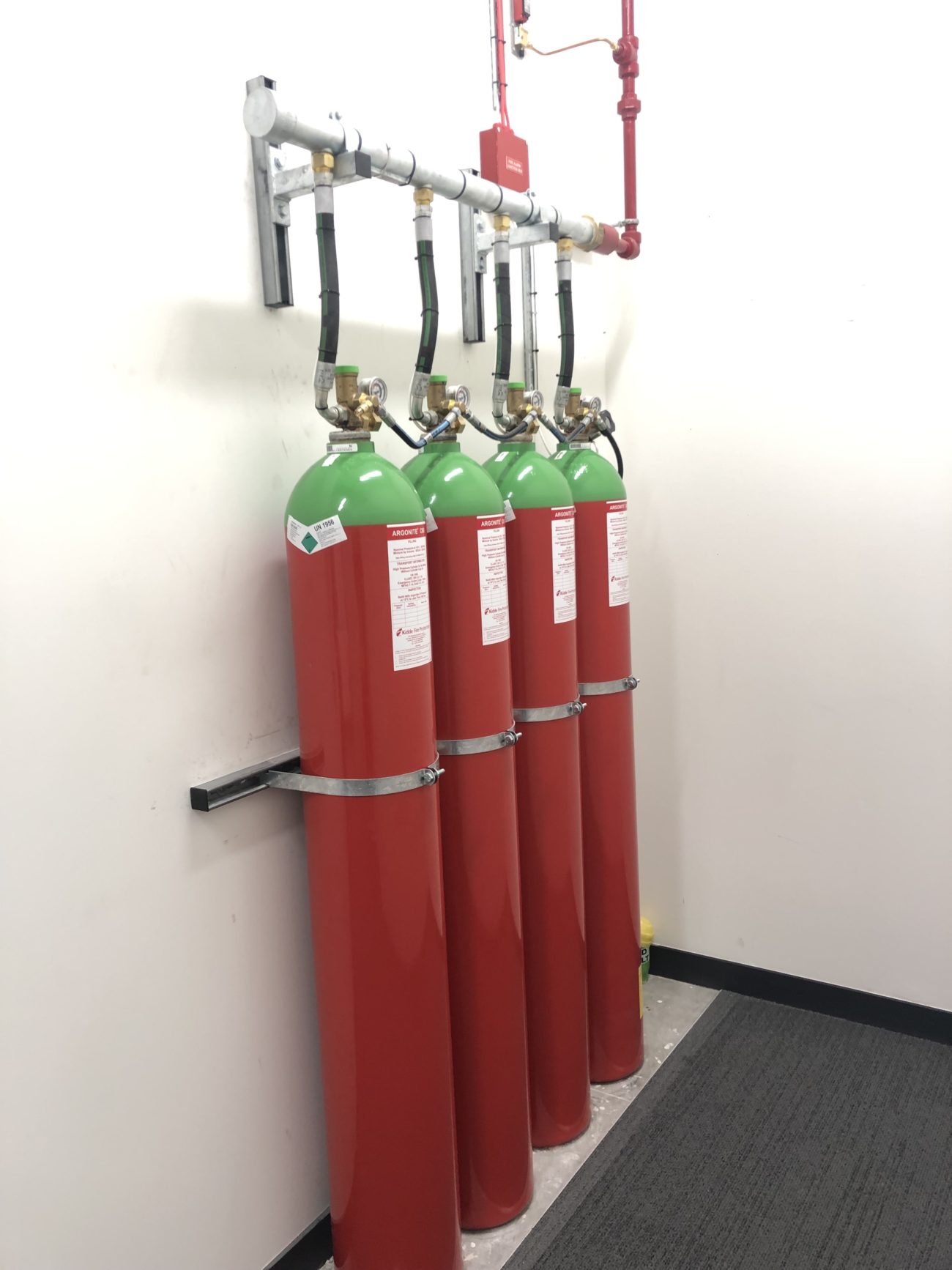
Server room fire suppression Kenya systems protect critical IT infrastructure from fire without relying on conventional water discharge inside sensitive equipment spaces. Clean-agent systems, early detection, enclosure integrity, HVAC shutdown and correctly sequenced release controls work together to suppress fire while reducing the risk of secondary equipment damage.
For a server room, the cost of a fire is rarely limited to the physical equipment that burns. Smoke contamination, heat, power interruption, water damage, loss of cooling and extended downtime can create a much larger business impact.
Related Products
This makes server room fire suppression Kenya an important consideration for data centres, banks, telecommunications companies, hospitals, universities, government facilities, cloud infrastructure providers and businesses operating mission-critical IT systems.
A professional server room fire suppression Kenya strategy must therefore address both fire control and business continuity.
What Is Server Room Fire Suppression Kenya?
Server room fire suppression Kenya refers to engineered fire-protection systems designed to detect and suppress fires in rooms containing servers, networking equipment, UPS systems, storage systems and other sensitive electronic infrastructure. Clean-agent systems are commonly considered where avoiding conventional water discharge is a major requirement.
Unlike an ordinary office, a server room contains equipment that can be damaged by:
- Fire
- Smoke
- Heat
- Water
- Corrosive combustion products
- Power interruption
- Firefighting activities
A server room fire suppression Kenya system therefore needs to suppress a developing fire quickly while minimizing collateral damage.
A typical system may include:
- Very early smoke detection
- Fire alarm control panel
- Clean-agent cylinders
- Distribution pipework
- Discharge nozzles
- Manual release station
- Abort control where applicable
- Audible and visual alarms
- HVAC shutdown
- Damper control
- Equipment shutdown interfaces
- Pressure-relief provisions
- Room integrity testing
The exact configuration depends on the hazard, room construction and selected suppression technology.
Why Server Rooms Need Special Fire Protection
Server rooms contain high-value electrical and electronic equipment in relatively concentrated spaces. A conventional water-based response can create additional damage, while a slow fire response can interrupt critical services. Server room fire suppression Kenya therefore combines early detection with an engineered suppression method appropriate for sensitive assets.
The risks may include:
- Electrical faults
- Overheated power supplies
- UPS failures
- Battery incidents
- Cable overheating
- Short circuits
- Cooling-system failures
- Arcing
- Combustible cable insulation
- Packaging or stored materials
The fire may begin inside equipment racks where conventional visual detection can be delayed.
That is why server room fire suppression Kenya should not rely solely on a conventional smoke detector mounted at ceiling level.
Early detection can provide valuable additional response time.
Why Water Can Be a Problem in Data Centres
Water can be highly effective for controlling many building fires, but sensitive IT environments require careful consideration of water exposure, equipment configuration and business continuity. Server room fire suppression Kenya therefore often evaluates clean-agent protection where the protected equipment and hazard are appropriate for gaseous suppression.
Water damage can result from:
- Sprinkler activation
- Firefighting hoses
- Pipe leaks
- Accidental discharge
- Cooling-system failures
- Flooding
- Roof leaks
The important distinction is that water is not universally “wrong” for data centres.
A properly engineered building may use water-based fire protection as part of its overall fire strategy.
However, the server room fire suppression Kenya system protecting a critical electronic enclosure may require additional specialized protection.
The appropriate approach depends on:
- Room classification
- Equipment
- Building design
- Fire strategy
- Applicable standards
- Authority requirements
- Risk assessment
Clean-Agent Fire Suppression for Server Rooms
Clean-agent fire suppression uses gaseous extinguishing agents designed to suppress fire without leaving conventional water or dry-chemical residue. This makes clean-agent technology attractive for suitable server rooms because equipment can potentially remain substantially less contaminated after suppression than with conventional extinguishing media.
Clean-agent systems can be considered for:
- Server rooms
- Data halls
- Network rooms
- Telecommunications rooms
- Control rooms
- UPS rooms
- Electrical equipment rooms
- Critical archives
The system must be correctly designed for the protected enclosure.
A cylinder installed in a server room does not automatically constitute a complete server room fire suppression Kenya system.
The engineering must determine:
- Protected volume
- Agent quantity
- Design concentration
- Discharge arrangement
- Nozzle locations
- Detection sequence
- HVAC shutdown
- Room integrity
- Pressure relief
- Occupancy
- Safety controls
How Clean-Agent Suppression Works
A clean-agent system suppresses fire by rapidly introducing the calculated quantity of extinguishing agent into the protected enclosure and achieving the required design concentration. The room must retain sufficient agent for the required period for the system to control the fire effectively.
This is why enclosure integrity is fundamental.
The suppression system and the building enclosure are effectively one engineered system.
If the room has large uncontrolled leakage paths, the agent can escape before the required concentration is maintained.
A professional server room fire suppression Kenya design therefore includes both suppression equipment and enclosure assessment.
Server Room Fire Suppression Kenya and Room Integrity
Room integrity is the ability of a protected enclosure to retain the required clean-agent concentration for the specified holding period. An enclosure integrity or door-fan test identifies significant leakage paths and helps establish whether the room can maintain the concentration required for suppression.
This is one of the most important elements of server room fire suppression Kenya.
Potential leakage paths include:
- Door gaps
- Cable penetrations
- Pipe penetrations
- Raised-floor openings
- Ceiling voids
- HVAC openings
- Unsealed walls
- Damaged fire stopping
- Service penetrations
A room can pass commissioning and later fail integrity because of building modifications.
For example:
A contractor installs new network cables through a previously sealed wall penetration.
The new opening may become a significant leakage path.
That means server room fire suppression Kenya requires ongoing enclosure management, not just a one-time installation.
What Is a Room Integrity Test?
A room integrity test, commonly performed using door-fan equipment, evaluates leakage in the protected enclosure and predicts whether the room can retain the required clean-agent concentration. The test allows leakage problems to be identified without performing a full agent discharge.
The test generally involves:
- Installing the test fan
- Pressurizing or depressurizing the room
- Measuring airflow
- Identifying leakage characteristics
- Calculating equivalent leakage
- Predicting agent retention
- Identifying areas requiring sealing
The resulting report should be retained with the fire-protection documentation.
A server room fire suppression Kenya project should not be considered complete until the enclosure has been assessed according to the applicable design standard.
HVAC Shutdown and Clean-Agent Protection
HVAC systems can rapidly remove clean agent from a protected room if they continue operating during discharge. Server room fire suppression Kenya therefore normally requires coordinated control of air-handling equipment, dampers and other ventilation interfaces according to the approved cause-and-effect sequence.
The system may need to:
- Stop supply fans
- Stop return fans
- Close dampers
- Isolate selected ventilation paths
- Control recirculation
- Coordinate with the fire alarm panel
The exact sequence must be engineered.
A clean-agent system cannot achieve its design concentration if the ventilation system continuously removes the agent.
This makes HVAC integration a critical part of server room fire suppression Kenya.
Pressure Relief in Protected Rooms
A tightly sealed room improves agent retention but can also experience pressure changes during discharge. Pressure-relief provisions may therefore be required to protect the enclosure from excessive pressure while still maintaining the required suppression concentration.
This creates an engineering balance.
The room must be:
- Tight enough to retain agent
- Strong enough to withstand pressure changes
- Properly protected against excessive pressure
A pressure-relief opening that is incorrectly sized can compromise enclosure integrity.
Therefore, server room fire suppression Kenya design should evaluate:
- Room construction
- Door construction
- Ceiling system
- Raised floor
- Pressure-relief requirements
- Agent discharge characteristics
- Ventilation configuration
Early Smoke Detection
Early smoke detection gives a server room suppression system more time to respond before a small electrical fault develops into a major fire. Very early warning systems can therefore complement conventional detection and clean-agent suppression in critical facilities.
Detection options may include:
- Point smoke detectors
- Aspirating smoke detection
- Multi-criteria detection
- Very early warning systems
Aspirating systems can continuously draw air samples from protected areas.
Sampling points can be positioned around:
- Server racks
- Ceiling voids
- Raised floors
- Return-air paths
- High-risk equipment
The detection design should be coordinated with the suppression release logic.
Server Room Fire Suppression Kenya Cause-and-Effect Sequence
The cause-and-effect sequence defines how detection, alarm, HVAC shutdown, equipment interfaces, warning signals and suppression release interact. A correctly tested sequence ensures that the system does not simply discharge agent but performs the complete safety response expected by the design.
A simplified sequence may be:
First-stage detection → Alarm → Second-stage confirmation → HVAC shutdown → Warning period → Agent release
The actual sequence depends on the system design.
Possible inputs include:
- Detector activation
- Cross-zone confirmation
- Manual release
- Abort activation
Possible outputs include:
- Audible alarm
- Visual alarm
- HVAC shutdown
- Damper closure
- Equipment shutdown
- Agent release
- Building fire alarm signal
A professional server room fire suppression Kenya commissioning process should test the complete sequence.
Clean-Agent Options for Data Centres
Clean-agent selection should be based on the hazard, occupancy, equipment, enclosure, agent characteristics, environmental considerations, manufacturer support and applicable standards. The choice should not be based solely on the agent’s brand name or initial equipment price.
Potential clean-agent categories include:
- Halocarbon agents
- Inert gas agents
- Other listed clean-agent technologies
Historically, FM-200 and Novec 1230 have been widely discussed in data-centre applications. Current project specifications should verify product availability, regulatory status and long-term support before procurement.
For a new server room fire suppression Kenya project, the engineer should confirm the agent’s current suitability and availability.
FM-200 in Server Rooms
FM-200, also known as HFC-227ea, has been used in clean-agent fire suppression systems protecting electronic equipment. It can provide rapid gaseous suppression without conventional water or dry-chemical residue, subject to proper design and applicable requirements.
FM-200 systems can involve:
- Agent cylinders
- Pressure containers
- Distribution pipework
- Nozzles
- Detection
- Releasing panels
- Alarm interfaces
The system requires appropriate enclosure integrity.
The agent quantity should be calculated based on the protected volume and required design concentration.
A server room fire suppression Kenya system using FM-200 should also consider current environmental and regulatory requirements before specification.
Novec 1230 and Current Project Selection
Novec 1230 has historically been used as a clean-agent technology for sensitive equipment, but current project specifications should verify product availability, manufacturer support and regulatory considerations before selecting it for a new installation.
A modern server room fire suppression Kenya assessment should ask:
- Is the product currently available?
- Is the manufacturer supporting the product?
- Are cylinders and valves available?
- Can the system be serviced locally?
- Is replacement agent available?
- What are the applicable environmental requirements?
- Does the system have the necessary listing or approval?
This is more useful than selecting an agent based only on historical popularity.
Inert Gas Systems
Inert-gas systems use gases such as nitrogen or gas mixtures to reduce the oxygen concentration to a level where combustion cannot continue, while maintaining a concentration suitable for the designed hazard and occupancy. They can be considered for appropriate data-centre applications where enclosure and cylinder-storage requirements can be accommodated.
Potential considerations include:
- Larger cylinder banks
- Higher storage pressure
- Cylinder-room requirements
- Discharge noise
- Pressure relief
- Room integrity
- Agent availability
An inert-gas solution may be appropriate where its engineering characteristics match the facility.
Therefore, server room fire suppression Kenya should compare clean-agent technologies based on the complete installation.
Water-Based Fire Protection and Data Centres
Water should not automatically be excluded from a data-centre fire strategy. Sprinklers and other water-based systems can form part of an overall building protection strategy when properly engineered, while specialized clean-agent systems may provide additional protection for specific critical electronic spaces.
The correct strategy depends on:
- Building classification
- Fire compartmentation
- Risk assessment
- Equipment arrangement
- Applicable codes
- Authority requirements
The objective of server room fire suppression Kenya is not simply to eliminate water from the entire building.
It is to determine where water-based and gaseous systems are appropriate.
Server Room Fire Suppression Kenya Technical Specification
Technical specifications should define the protected enclosure, suppression agent, design concentration, cylinder arrangement, piping, nozzle locations, detection sequence, room integrity requirements, pressure-relief provisions and control interfaces.
| Engineering Parameter | Why It Matters |
|---|---|
| Protected room volume | Determines agent quantity |
| Ceiling height | Affects agent distribution |
| Raised floor | May form part of protected volume |
| Ceiling void | May require protection |
| Agent type | Determines system characteristics |
| Design concentration | Establishes suppression target |
| Nozzle arrangement | Controls agent distribution |
| Pipe network | Delivers agent to discharge points |
| Detection | Initiates suppression sequence |
| HVAC controls | Prevents agent loss |
| Room integrity | Supports agent retention |
| Pressure relief | Protects enclosure |
| Occupancy | Determines life-safety requirements |
| Manual release | Provides emergency activation |
| Abort function | May provide controlled interruption where designed |
A complete server room fire suppression Kenya design should document these parameters.
Server Room Fire Suppression Kenya for Data Centres
Large data centres require layered protection because the consequences of fire can extend beyond physical equipment to network availability, financial systems, telecommunications and customer services. Server room fire suppression Kenya should therefore form part of a broader fire and business-continuity strategy.
A data centre may contain:
- Server halls
- Network rooms
- UPS rooms
- Battery rooms
- Electrical switchrooms
- Generator rooms
- Cooling plants
- Storage areas
- Operations centres
Each area may require different fire-protection measures.
A clean-agent system appropriate for a server hall may not be appropriate for a battery room or generator enclosure.
Server Room Fire Suppression Kenya for Banks
Banks depend heavily on continuous IT availability, making fire protection of server and network infrastructure a business-continuity issue. Clean-agent suppression can be considered for appropriate enclosed technology rooms where protecting equipment from secondary damage is important.
Banking facilities should consider:
- Core servers
- Network infrastructure
- UPS systems
- Backup systems
- Telecommunications
- Security systems
- Data storage
The fire strategy should also address backup power and redundant IT infrastructure.
Server Room Fire Suppression Kenya for Hospitals
Hospitals depend on electronic systems for clinical records, diagnostics, communications and operational management. Fire protection for server rooms must therefore consider equipment protection, staff safety, service continuity and integration with the hospital’s overall emergency systems.
Potentially protected areas include:
- IT rooms
- Data centres
- Network rooms
- Communications rooms
- Control rooms
The system should be designed so that emergency alarms do not create unnecessary operational disruption.
Server Room Fire Suppression Kenya for Telecommunications
Telecommunications facilities contain high-value switching, transmission and network equipment that can be vulnerable to fire and smoke. Server room fire suppression Kenya systems can provide specialized protection for suitable enclosed telecommunications spaces while supporting service continuity.
The assessment should consider:
- Rack density
- Cable loading
- Battery systems
- Power supplies
- HVAC
- Remote monitoring
- Room access
Remote facilities may also require additional consideration for maintenance and emergency response.
Server Room Fire Suppression Kenya for Universities
Universities increasingly rely on centralized digital infrastructure for learning platforms, administration, research and communications. Protecting server rooms requires an engineered combination of early detection, appropriate suppression, room integrity and trained personnel.
University facilities should also consider:
- Multiple server rooms
- Research computing
- Network rooms
- Backup power
- Student access
- Maintenance contractors
Room Integrity Test Checklist
A room integrity test should verify that the enclosure can retain the clean agent for the required design period. The test should identify leakage through doors, cable penetrations, ceilings, floors, ducts and other building interfaces before the system is accepted.
| Inspection Area | Check |
| Doors | Seals and closing mechanism |
| Cable penetrations | Fire stopping intact |
| Raised floor | Openings sealed |
| Ceiling | Panels and penetrations intact |
| HVAC | Dampers close correctly |
| Walls | No uncontrolled openings |
| Pipes | Penetrations sealed |
| Access panels | Properly fitted |
| Pressure relief | Correct provision |
| Room volume | Matches drawings |
| Leakage | Measured and assessed |
| Test report | Documented |
This checklist is an important part of server room fire suppression Kenya commissioning.
Installation and Commissioning
Professional installation ensures that the suppression system matches the approved design and that detection, controls, pipework, nozzles, HVAC interfaces and enclosure conditions operate together. NFPA 2001 acceptance provisions include checking actual hazard dimensions, equipment installation, agent quantity, piping and relevant fan or damper operation.
The installation process should include:
Phase 1: Site Survey
Record:
- Room dimensions
- Equipment
- Ceiling height
- Raised floor
- HVAC
- Occupancy
- Cable penetrations
Phase 2: Hazard Assessment
Identify:
- Fire sources
- Combustible materials
- Electrical risks
- Critical equipment
Phase 3: System Design
Calculate:
- Agent quantity
- Pipework
- Nozzle locations
- Detection zones
- Control sequence
Phase 4: Installation
Install approved components according to the design.
Phase 5: Integration
Connect:
- Fire alarm
- HVAC
- Dampers
- Equipment interfaces
- Manual release
- Warning devices
Phase 6: Integrity Testing
Test the room enclosure.
Phase 7: Commissioning
Test the complete cause-and-effect sequence.
Phase 8: Handover
Provide:
- Drawings
- Test certificates
- Maintenance instructions
- System manuals
- Training records
Server Room Fire Suppression Kenya Commissioning Checklist
Commissioning confirms that the installed system can perform its intended functions and that the protected enclosure corresponds with the design. The system should not be handed over until critical detection, alarm, release, shutdown and enclosure requirements have been verified.
| Commissioning Requirement | Status |
| Approved drawings available | ☐ |
| Room dimensions verified | ☐ |
| Agent quantity verified | ☐ |
| Cylinders correctly secured | ☐ |
| Pipework inspected | ☐ |
| Nozzles correctly positioned | ☐ |
| Detection tested | ☐ |
| Alarm tested | ☐ |
| Manual release tested | ☐ |
| Abort function tested where applicable | ☐ |
| HVAC shutdown tested | ☐ |
| Damper operation verified | ☐ |
| Pressure relief assessed | ☐ |
| Room integrity test completed | ☐ |
| Cause-and-effect verified | ☐ |
| Warning signage installed | ☐ |
| Emergency procedures documented | ☐ |
| Personnel trained | ☐ |
| Maintenance schedule established | ☐ |
| Final documentation handed over | ☐ |
Maintenance of Server Room Fire Suppression Kenya Systems
Maintenance is essential because a clean-agent system can become ineffective even when its cylinders and control panel appear normal. Building modifications, cable penetrations, failed door seals and HVAC changes can compromise the protected enclosure.
Maintenance should consider:
- Agent cylinder condition
- Cylinder pressure or weight
- Valves
- Pipework
- Nozzles
- Detection devices
- Control panel
- Manual release
- Alarm devices
- HVAC interfaces
- Dampers
- Room integrity
NFPA-based guidance emphasizes maintaining the enclosure and correcting changes that could prevent the protected space from maintaining the required agent concentration.
A strong server room fire suppression Kenya maintenance programme therefore covers both the fire equipment and the building enclosure.
Common Server Room Fire Protection Mistakes
Many server-room protection failures occur because the suppression equipment is treated separately from the room. A clean-agent system can be properly installed yet fail to perform as intended if enclosure leakage, HVAC operation, detection or equipment changes are ignored.
1. Installing Cylinders Without Testing the Room
Agent quantity cannot compensate indefinitely for uncontrolled leakage.
2. Leaving HVAC Running
Air movement can interfere with agent retention and discharge performance.
3. Adding Cable Penetrations Without Sealing Them
Every new penetration can change enclosure integrity.
4. Ignoring the Raised Floor
The underfloor space may form part of the protected volume.
5. Installing the Wrong Nozzle Arrangement
Nozzle positioning must follow the approved system design.
6. Failing to Test the Cause-and-Effect Sequence
Individual components may pass while the integrated system fails.
7. Treating Maintenance as Cylinder Inspection Only
The room itself must remain suitable for suppression.
Fire Detection vs Fire Suppression
Fire detection and fire suppression perform different functions. Detection identifies the developing fire condition, while suppression controls or extinguishes the fire. A high-quality server room fire suppression Kenya strategy uses both technologies as coordinated layers of protection.
| Function | Detection | Suppression |
| Detect smoke | Yes | No |
| Identify developing fire | Yes | No |
| Sound alarm | Yes | Through system interface |
| Release extinguishing agent | Initiates sequence | Yes |
| Control fire | No | Yes |
| HVAC shutdown | Can initiate | Integrated |
| Manual activation | Control interface | Yes |
| Room integrity | No | Essential for total flooding |
This distinction is important when planning a data-centre fire strategy.
Server Room Fire Suppression Kenya and Compliance
Server room fire protection must satisfy the requirements applicable to the facility, adopted standards, equipment listings, manufacturer instructions and relevant Kenyan fire and occupational-safety requirements. The exact compliance pathway depends on the building, occupancy, system and authority having jurisdiction.
Kenya’s Directorate of Occupational Safety and Health Services states that it enforces the Occupational Safety and Health Act, 2007 and subsidiary requirements including the Fire Risk Reduction Rules.
The Occupational Safety and Health Act also requires suitable means for extinguishing fire and trained persons during working hours.
KEBS maintains the official gazetted-standards framework for Kenya, which should be checked when identifying applicable national standards.
For clean-agent systems, NFPA 2001 is an important international reference for clean-agent fire-extinguishing systems, subject to the edition and requirements adopted or specified for the project.
NFPA 2001 and Server Room Protection
NFPA 2001 provides technical requirements for clean-agent fire-extinguishing systems, including design, installation, acceptance testing and enclosure considerations. Project teams should always verify the current adopted edition rather than relying on an outdated copy or generic online summary.
Important design areas include:
- Agent concentration
- Hazard classification
- Enclosure integrity
- Pipework
- Nozzle arrangement
- Detection
- Control systems
- Acceptance testing
- Maintenance
NFPA 2001 acceptance provisions also address checking actual hazard dimensions, agent quantity, installation and system operation.
Information Required Before Designing a Server Room Fire Suppression Kenya System
A competent designer needs accurate information about the room before calculating a clean-agent system. Incorrect room dimensions, unrecorded ceiling voids, missing raised-floor areas or undocumented HVAC openings can produce an incorrect agent quantity and unreliable suppression performance.
Provide:
- Room length
- Room width
- Room height
- Raised-floor height
- Ceiling void height
- Door dimensions
- HVAC arrangement
- Equipment layout
- Occupancy
- Fire alarm information
- Cable penetrations
- Adjacent room conditions
For larger projects, provide architectural and MEP drawings.
Server Room Fire Suppression Kenya Cost Factors
The cost of server room fire suppression Kenya depends on protected volume, agent technology, cylinder quantity, detection equipment, pipework, nozzles, control systems, room modifications, integrity testing, commissioning and maintenance. A reliable quotation therefore requires technical information rather than room area alone.
Major cost factors include:
| Cost Component | Effect on Project Cost |
| Room volume | Determines agent quantity |
| Agent selection | Affects equipment and cylinders |
| Cylinder quantity | Affects storage requirements |
| Detection | Adds sensors and control infrastructure |
| Pipework | Depends on layout and distance |
| Nozzles | Depends on protected geometry |
| HVAC integration | Requires controls and interfaces |
| Room sealing | May require building modifications |
| Pressure relief | May require specialist equipment |
| Testing | Includes commissioning and integrity |
| Maintenance | Recurring lifecycle cost |
Therefore, a server room fire suppression Kenya quotation should be based on a site assessment and engineering design.
How to Select a Server Room Fire Suppression System
The best server-room suppression system is not determined by the lowest purchase price. Selection should balance fire performance, equipment protection, personnel safety, enclosure characteristics, environmental considerations, lifecycle support, maintenance requirements and compliance.
Use this engineering process:
1. Identify the Hazard
Determine likely fire sources.
2. Measure the Room
Calculate the actual protected volume.
3. Assess Equipment
Identify servers, UPS systems, batteries and other equipment.
4. Review Occupancy
Determine whether people regularly occupy the room.
5. Evaluate Suppression Options
Compare suitable clean-agent technologies.
6. Evaluate the Enclosure
Assess leakage, HVAC and pressure relief.
7. Design Detection
Determine appropriate smoke detection and release logic.
8. Design Interfaces
Coordinate alarms, HVAC and equipment shutdown.
9. Test the System
Complete functional and enclosure testing.
10. Establish Maintenance
Maintain both equipment and room integrity.
Why Professional Engineering Matters
A server-room suppression system is a life-safety and business-continuity system, not simply a collection of cylinders and pipes. Professional engineering ensures that the suppression agent, detection, enclosure, HVAC, controls and commissioning process work together as a complete system.
Megtraco Kenya Ltd provides fire suppression equipment for applicable commercial and industrial fire-protection applications.
Facilities can also review control panel solutions for fire-system control and integration requirements.
For broader protection planning, businesses can request professional engineering consultation based on their facility and hazard.
Frequently Asked Questions
What Is Server Room Fire Suppression Kenya?
Server room fire suppression Kenya refers to specialized fire-protection systems designed to protect server rooms, data centres and other critical electronic spaces from fire while minimizing damage to sensitive equipment. Clean-agent suppression is one technology considered for suitable enclosed spaces.
Why Is Water Not Always Preferred in Server Rooms?
Water can damage sensitive electronic equipment and disrupt operations, so specialized clean-agent systems may be considered for appropriate critical IT spaces. However, water-based protection can still form part of the wider building fire strategy where correctly engineered.
What Is a Clean-Agent Fire Suppression System?
A clean-agent system uses a gaseous extinguishing agent to achieve a calculated concentration within a protected enclosure. It is designed to suppress fire without leaving conventional water or dry-chemical residue on protected equipment.
What Is a Room Integrity Test?
A room integrity test measures leakage in a protected enclosure and predicts whether the room can maintain the required clean-agent concentration for the specified holding period. Door-fan testing is a common method used to evaluate enclosure integrity.
Why Is Room Integrity Important?
Room integrity is important because a clean-agent system depends on maintaining the required extinguishing concentration. Significant leakage through doors, cable penetrations, ceilings or HVAC openings can reduce agent retention and compromise suppression performance.
Does a Server Room Need Smoke Detection?
Yes, an engineered server-room fire strategy should include appropriate fire detection. Early smoke detection can provide additional warning time and allow the suppression sequence to operate before a developing equipment fire becomes more severe.
Does the HVAC System Need to Shut Down?
HVAC operation must be considered because continuous airflow can affect agent retention and distribution. The required shutdown and damper sequence should be determined by the system design and tested during commissioning.
How Often Should Room Integrity Be Tested?
Testing frequency should follow the applicable edition of the adopted standard, manufacturer requirements and changes to the enclosure. Building alterations, new cable penetrations and HVAC modifications can justify reassessment even before a scheduled test.
Can a Server Room Use FM-200?
FM-200 has been used for suitable clean-agent applications involving electronic equipment. Any new installation should verify current product availability, environmental requirements, manufacturer support and the applicable design standard before specification.
Can Novec 1230 Be Used in a Data Centre?
Novec 1230 has historically been used for sensitive equipment protection, but current project teams should verify product availability, manufacturer support, regulatory considerations and approved system components before specifying it for a new installation.
What Happens When the Clean-Agent System Activates?
A typical sequence may involve confirmed fire detection, alarm notification, HVAC shutdown, warning signals, equipment interfaces and agent discharge. The exact sequence is project-specific and should be documented in the approved cause-and-effect matrix.
How Much Does Server Room Fire Suppression Kenya Cost?
The cost varies according to room volume, agent type, cylinder quantity, detection, pipework, nozzles, control equipment, HVAC interfaces, enclosure modifications, testing and commissioning. An accurate quotation requires technical information and normally a site assessment.
Does Server Room Fire Suppression Kenya Protect the Raised Floor?
It can, where the raised floor forms part of the protected volume. The designer must determine whether the underfloor space contains combustible materials, cables or other hazards requiring suppression coverage and include the volume in the engineering calculations where applicable.
Can New Cables Be Installed After Commissioning?
Yes, but new cable penetrations can compromise room integrity. Any new penetration should be properly sealed and the effect on the clean-agent enclosure should be assessed before the room is considered fully protected.
Engineering Conclusion
Server room fire suppression Kenya is fundamentally about protecting both the fire hazard and the continuity of critical digital infrastructure. A successful system combines early detection, appropriate clean-agent technology, correct agent quantity, room integrity, HVAC control, pressure management, alarm sequencing and professional commissioning.
The suppression equipment is only one part of the system.
The room itself must also perform correctly.
That means maintaining:
- Sealed cable penetrations
- Functional doors
- Proper HVAC dampers
- Correct room dimensions
- Appropriate pressure relief
- Correct nozzle positions
- Functional detection
- Tested controls
- Documented maintenance
A clean-agent cylinder cannot compensate for a poorly designed or heavily leaking enclosure.
For this reason, every server room fire suppression Kenya project should begin with a technical assessment of the hazard and protected room.
The design should then determine the appropriate clean-agent technology, detection strategy, discharge arrangement and control sequence.
For data centres, banks, hospitals, telecommunications facilities, universities and other organizations operating critical IT infrastructure, professional fire-protection engineering can reduce the risk of prolonged service interruption and unnecessary equipment damage.
Megtraco Kenya Ltd can support organizations evaluating server room fire suppression Kenya requirements through fire-suppression equipment, control systems and professional engineering support.
Businesses planning a new data centre, upgrading an existing server room or reviewing fire-protection compliance can explore fire suppression equipment or request a customized engineering quotation.
Your Trusted LPG & Fire Safety Engineering Partner in East Africa
Whether you’re designing a new LPG installation, upgrading industrial gas systems, or enhancing fire safety compliance, Megtraco Kenya Ltd delivers certified engineering solutions backed by decades of expertise. From LPG equipment supply and pipeline installations to fire suppression and detection systems, our experienced team provides reliable solutions for commercial, industrial, and institutional projects across East Africa.
Contact us today for professional consultation, engineering support, or a customized quotation.
WHY CHOOSE MEGTRACO KENYA LTD
- ✔ Established Since 1969 – Decades of proven engineering excellence.
- ✔ KEBS Certified Products – Guaranteed quality and compliance with regional standards.
- ✔ EPRA Licensed LPG Engineering Company – Fully certified to design, install, and commission.
- ✔ Industrial & Commercial LPG Specialists – Scaled to handle heavy-duty thermal requirements.
- ✔ Fire Suppression & Fire Detection Experts – End-to-end asset protection.
- ✔ Regional Operational Footprint – Serving Nairobi, Mombasa, Kisumu, Nakuru, Eldoret, Thika, Machakos, East Africa, and beyond.
Contact Megtraco Kenya Ltd
- Email: sales@megtracokenya.com
- Sales: +254 725 870 114
- Technical: +254 733 721 598
- WhatsApp: +254 799 086 323
- Location: Nairobi, Kenya – Serving East Africa
- Website: https://megtracokenya.com
Request a Quote today and partner with East Africa’s trusted LPG and fire safety engineering company since 1969.
