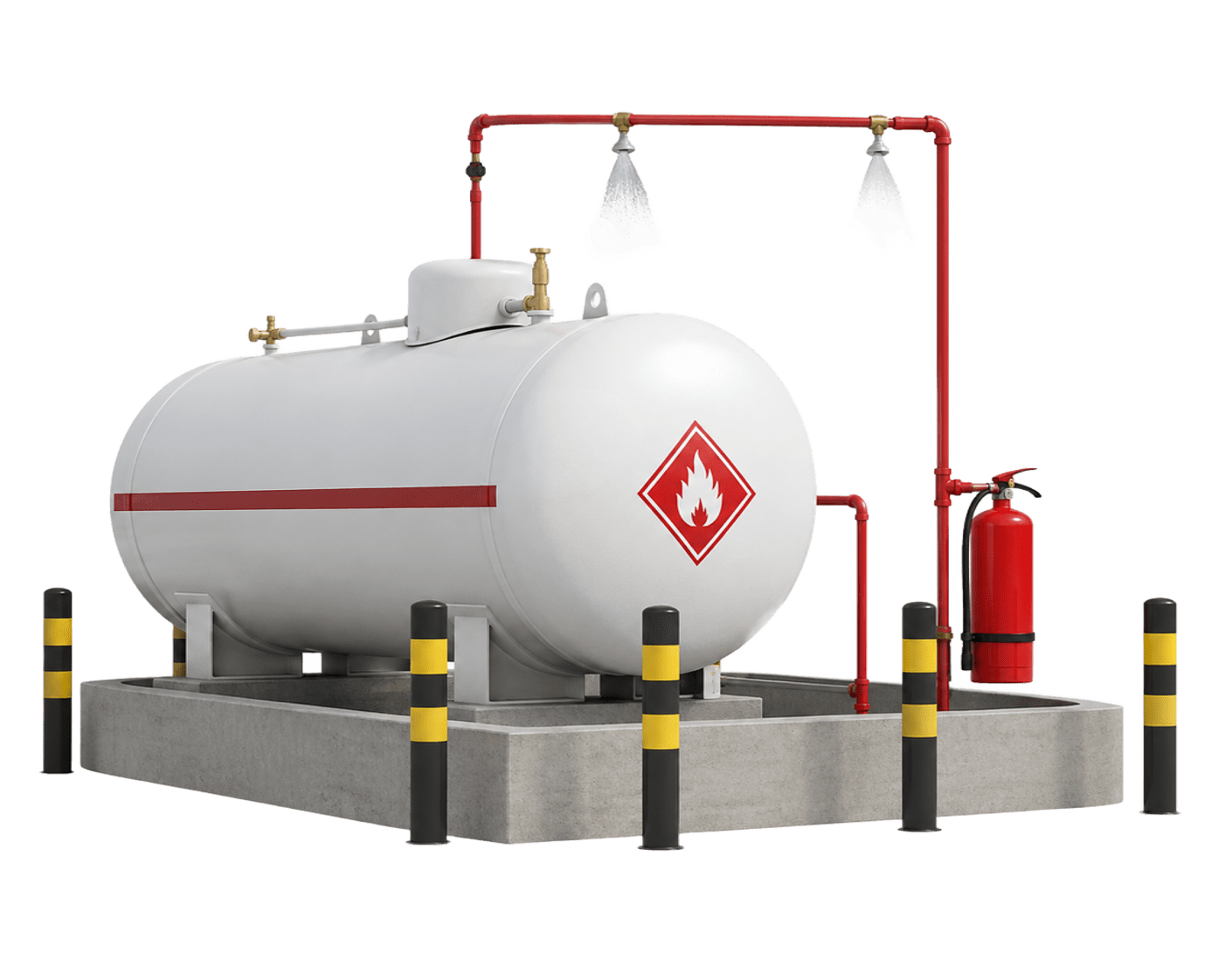
LPG tank fire protection is one of the most important aspects of designing a safe LPG storage installation. Whether the system serves a residential estate, apartment complex, hotel, factory, school, or commercial facility, effective LPG tank fire protection begins long before the first litre of gas is delivered. It starts with proper site planning, safe separation distances, emergency access, and compliance with recognised engineering standards.
Liquefied Petroleum Gas (LPG) is a highly efficient fuel, but like any flammable energy source, it must be stored and handled correctly. A poorly positioned storage tank can increase the risk of fire spreading to nearby buildings, restrict emergency response, or expose the tank to unnecessary hazards.
Related Products

Fortunately, these risks can be significantly reduced through professional engineering and careful site layout.
Understanding LPG tank fire protection enables property owners, developers, and facility managers to make informed decisions when planning new LPG installations or upgrading existing systems.
Megtraco Kenya Ltd provides professionally designed LPG reticulation systems, bulk LPG storage systems, commercial LPG installations, and LPG engineering solutions that prioritise safety, regulatory compliance, and long-term operational reliability.
LPG Tank Fire Protection: Why Site Layout Matters
Direct Answer: LPG tank fire protection starts with proper site layout. Correct tank positioning, adequate separation distances, and unrestricted emergency access reduce fire risks, protect nearby structures, and allow emergency services to respond quickly if an incident occurs.
Every LPG installation is unique.
A storage tank serving a hotel has different requirements from one supplying a residential apartment or manufacturing facility.
However, every installation should follow the same fundamental principles.
A good site layout helps to:
- Reduce fire hazards.
- Protect people and property.
- Minimise equipment damage.
- Improve emergency access.
- Support safe LPG deliveries.
- Simplify maintenance and inspections.
Ignoring these principles during the planning stage can create expensive problems later.
Relocating a storage tank after installation is significantly more costly than selecting the correct location from the beginning.
Understanding LPG tank fire protection before construction starts saves both time and money.
LPG Tank Fire Protection: Identifying Fire Hazards
Every LPG installation should begin with a detailed fire risk assessment. Understanding LPG tank fire protection means identifying hazards before they become safety problems.
Potential hazards include:
- Nearby buildings.
- Electrical equipment.
- Vehicle traffic.
- Open flames.
- Welding activities.
- Smoking areas.
- Waste burning.
- Diesel generators.
- Fuel storage areas.
Each of these can become a potential ignition source if not properly managed.
Professional LPG engineers assess these hazards before deciding where a storage tank should be located.
This is one of the most important stages of LPG tank fire protection planning.
LPG Tank Fire Protection: Planning Safe Tank Locations
Choosing the right location is one of the simplest ways to improve LPG tank fire protection.
A well-positioned tank should:
- Be easy to access for LPG delivery vehicles.
- Remain clear of unnecessary pedestrian traffic.
- Be protected from vehicle impact.
- Allow easy inspection.
- Provide sufficient ventilation.
- Maintain required safety clearances.
Professional designers also consider future site expansion.
For example, a storage tank installed too close to a future building extension may create compliance problems later.
Good planning ensures the LPG installation remains safe throughout the life of the facility.
LPG Tank Fire Protection: Protecting Nearby Buildings
Buildings are among the primary considerations when planning LPG tank fire protection.
Storage tanks should never be positioned where a fire could quickly spread between the tank and occupied structures.
Engineers evaluate:
- Building construction materials.
- Occupancy levels.
- Emergency exits.
- Fire escape routes.
- External wall openings.
Maintaining appropriate separation distances reduces heat exposure during emergencies and allows firefighters to operate safely.
LPG Tank Fire Protection: Managing Ignition Sources
One of the most important objectives of LPG tank fire protection is keeping ignition sources away from LPG storage.
Common ignition sources include:
- Electrical sparks.
- Open flames.
- Hot machinery.
- Welding equipment.
- Smoking.
- Vehicle exhaust systems.
By controlling these hazards, the likelihood of ignition is significantly reduced.
Professional LPG engineering solutions include hazard identification and site planning to minimise these risks before installation begins.
LPG Tank Fire Protection: Understanding Separation Distances
Direct Answer: LPG tank fire protection depends heavily on maintaining minimum separation distances between LPG storage tanks, buildings, roads, property boundaries, and ignition sources.
These safety distances serve several purposes.
They:
- Reduce radiant heat exposure.
- Slow fire spread.
- Protect nearby structures.
- Improve emergency access.
- Allow maintenance activities.
The required distance depends on several factors, including:
- Tank size.
- LPG storage capacity.
- Installation type.
- Local regulations.
- Applicable engineering standards.
Because every project is different, separation distances should always be determined during professional system design rather than estimated on-site.
LPG Tank Fire Protection: Tank-to-Building Separation
Maintaining adequate clearance between storage tanks and buildings is one of the most effective methods of improving LPG tank fire protection.
Proper spacing:
- Reduces heat transfer.
- Protects occupants.
- Supports evacuation.
- Allows emergency responders to operate safely.
The larger the LPG storage capacity, the more important these separation distances become.
LPG Tank Fire Protection: Tank-to-Boundary Clearance
Property boundaries also play an important role in LPG tank fire protection.
Installing a storage tank too close to neighbouring properties may expose adjacent buildings to unnecessary risk.
Adequate boundary clearance:
- Improves public safety.
- Simplifies maintenance.
- Reduces legal disputes.
- Supports regulatory compliance.
Professional LPG designers consider both current property boundaries and future developments during site planning.
LPG Tank Fire Protection: Vehicle Impact Protection
LPG storage tanks located near roads, loading bays, or parking areas require additional protection against accidental vehicle collisions.
Protective measures may include:
- Steel crash barriers.
- Concrete bollards.
- Protective walls.
- Clearly marked exclusion zones.
Vehicle protection forms an important part of comprehensive LPG tank fire protection, particularly for commercial and industrial installations.
LPG Tank Fire Protection: Emergency Access Routes
Emergency services must be able to reach the LPG installation quickly during an incident.
Effective LPG tank fire protection therefore requires:
- Wide access roads.
- Unobstructed entrances.
- Clear turning areas.
- Space for firefighting equipment.
- Easy access to isolation valves.
Blocked access routes can delay emergency response and increase the severity of an incident.
For this reason, emergency access should never be treated as an afterthought during LPG system design.