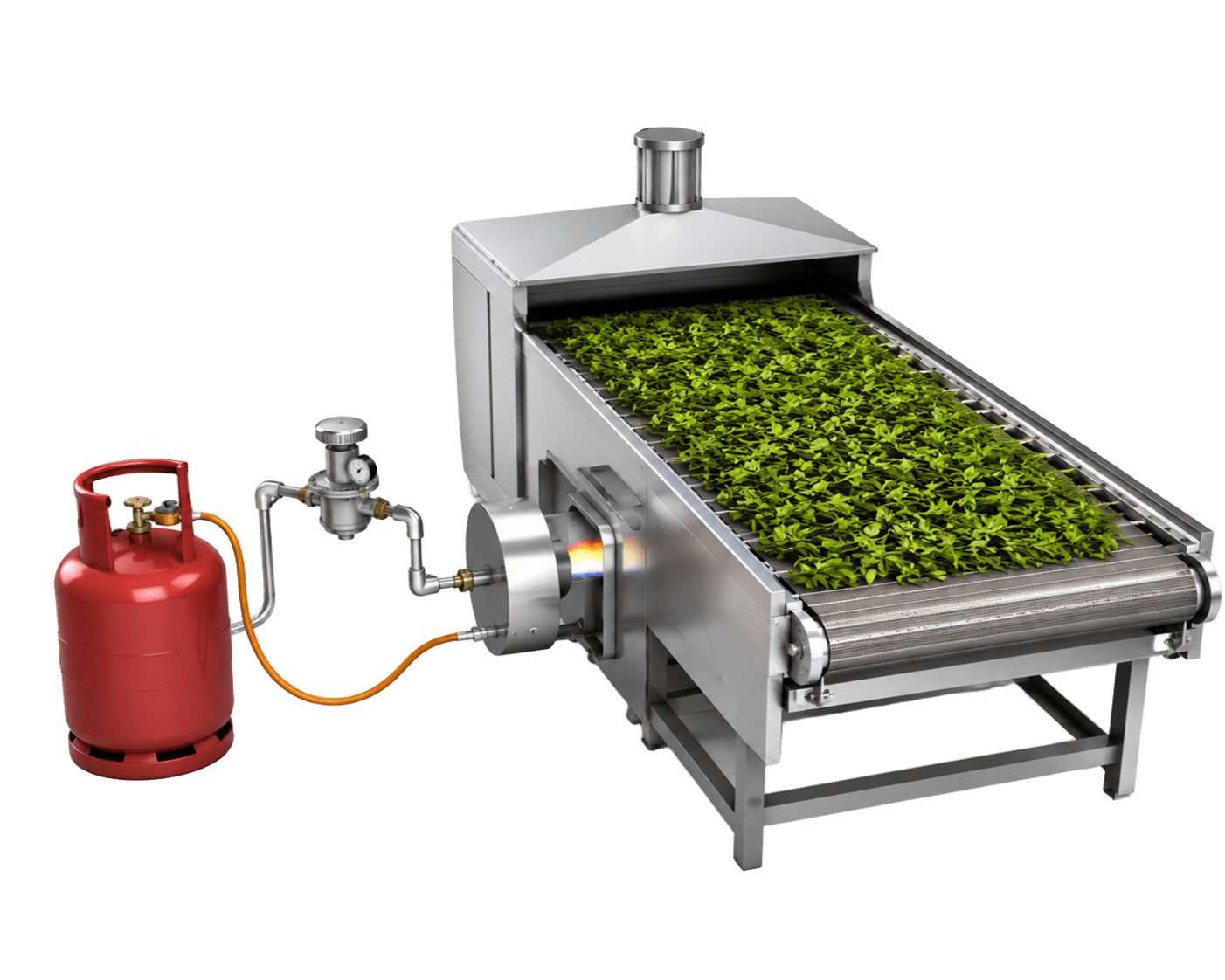
LPG for tea drying has become an increasingly attractive energy solution for tea factories and coffee processors seeking reliable heat, improved product quality, and greater production efficiency. Unlike traditional fuels that may produce uneven combustion or fluctuating temperatures, LPG for tea drying provides clean-burning energy that supports consistent drying conditions throughout long production runs.
However, fuel quality alone is not enough.
Related Products
The performance of LPG for tea drying depends heavily on maintaining stable vapour pressure from the storage tank to the burner. When vapour pressure drops, burners cannot receive a consistent gas supply, resulting in uneven temperatures, inconsistent moisture removal, lower product quality, and unnecessary production interruptions.
This issue is particularly important in Kenya’s tea-growing highlands, where cool ambient temperatures and continuous high gas demand can reduce the natural vaporisation rate of LPG.
Understanding LPG for tea drying enables factory owners, production managers, and engineers to design systems capable of delivering consistent heat throughout every drying cycle.
Megtraco Kenya Ltd supplies professionally engineered bulk LPG storage systems, LPG reticulation systems, vaporizers, industrial gas trains, and complete LPG engineering solutions for tea factories, coffee processors, and industrial facilities across Kenya and East Africa.
LPG for Tea Drying: Why Vapour Pressure Matters
Direct Answer: LPG for tea drying delivers reliable and consistent heat only when vapour pressure remains stable. Steady vapour pressure allows burners to operate efficiently, ensuring uniform drying temperatures and consistent batch quality.
Many factory operators focus on burner size when evaluating drying performance.
In reality, burner performance begins at the LPG storage tank.
LPG stored inside the tank exists primarily as a liquid.
Only the vapour above the liquid is supplied to the burner.
As the burner consumes gas, additional liquid must evaporate to replace the vapour being used.
If the liquid cannot vaporise quickly enough, vapour pressure begins to fall.
When this happens:
- Burner flames become unstable.
- Drying temperatures fluctuate.
- Heat output decreases.
- Production quality suffers.
Understanding LPG for tea drying therefore requires understanding how vapour pressure affects every stage of the drying process.
LPG for Tea Drying: Understanding Vapour Pressure
Vapour pressure is the pressure created naturally as LPG changes from liquid into gas.
This pressure supplies fuel to the burner.
Unlike pumps used in liquid fuel systems, LPG relies on natural vaporisation inside the storage tank.
Several factors influence vapour pressure, including:
- Ambient temperature.
- Tank size.
- LPG composition.
- Liquid level.
- Gas consumption rate.
When these factors remain balanced, LPG for tea drying operates smoothly with stable burner performance.
When they are not, production quality may decline.
LPG for Tea Drying: Why Vapour Pressure Drops
One of the most common causes of poor drying performance is falling vapour pressure.
This usually occurs because:
- Gas demand exceeds the tank’s natural vaporisation capacity.
- Ambient temperatures fall.
- Storage tanks are undersized.
- Multiple burners operate simultaneously.
- Continuous production increases gas consumption.
When vapour pressure falls below burner requirements, combustion becomes inconsistent.
Instead of receiving a steady gas supply, burners experience fluctuating fuel flow that affects drying temperatures.
Understanding these causes is essential when designing reliable LPG for tea drying systems.
LPG for Tea Drying: Highland Cold Weather Challenges
Kenya’s tea-growing regions often experience significantly lower temperatures than other parts of the country.
Factories located in areas such as:
- Kericho
- Nandi
- Nyeri
- Kiambu
- Murang’a
may experience cool mornings and extended periods of low ambient temperatures.
Lower temperatures reduce the natural evaporation rate inside LPG storage tanks.
As a result, LPG for tea drying becomes more challenging during continuous production because the tank cannot generate vapour quickly enough.
Professional LPG engineers account for these climatic conditions during system design.
LPG for Tea Drying: Heavy Gas Draw-Off Effects
Tea drying is a continuous industrial process.
Large burners may consume significant quantities of LPG every hour.
When several burners operate simultaneously, gas demand increases rapidly.
Heavy draw-off can cause:
- Pressure loss.
- Tank cooling.
- Reduced vaporisation.
- Lower burner performance.
- Uneven drying temperatures.
Professional LPG engineering solutions often include vaporizers to maintain stable gas supply during periods of high demand.
LPG for Tea Drying: How Stable Heat Improves Batch Quality
Direct Answer: LPG for tea drying improves product quality because stable burner temperatures produce consistent moisture removal throughout every drying cycle.
Tea processing depends on accurate temperature control.
Even small variations can influence:
- Moisture content.
- Leaf colour.
- Aroma.
- Flavour.
- Shelf life.
When burner temperatures fluctuate, drying becomes uneven.
Some sections of the batch may remain too wet.
Others may become overdried.
Both situations reduce final product quality.
Maintaining stable vapour pressure ensures LPG for tea drying delivers consistent heat throughout production.
LPG for Tea Drying: Consistent Drying Temperatures
Uniform drying temperatures produce several important benefits.
These include:
- Better product consistency.
- Reduced waste.
- Improved moisture control.
- Higher processing efficiency.
- Greater customer satisfaction.
Factories using properly designed LPG systems often experience more stable production compared with installations suffering frequent vapour pressure fluctuations.
LPG for Tea Drying: Protecting Tea and Coffee Quality
Both tea and coffee processing require careful moisture control.
Excess moisture can:
- Reduce storage life.
- Encourage mould growth.
- Lower product quality.
Overdrying can also damage flavour characteristics.
Reliable LPG for tea drying helps processors maintain the ideal balance between drying speed and product quality.
LPG for Tea Drying: Reducing Moisture Variations
Stable burner operation reduces moisture variations between batches.
This creates:
- More consistent product quality.
- Improved packaging performance.
- Better export standards.
- Reduced quality complaints.
Uniform drying is one of the major advantages of professionally engineered LPG systems.
LPG for Tea Drying: Improving Production Efficiency
Stable vapour pressure improves overall factory efficiency by:
- Reducing burner interruptions.
- Minimising downtime.
- Improving fuel utilisation.
- Increasing production consistency.
- Supporting continuous operation.
Correctly designed LPG for tea drying systems allow factories to maintain productivity even during extended production schedules.