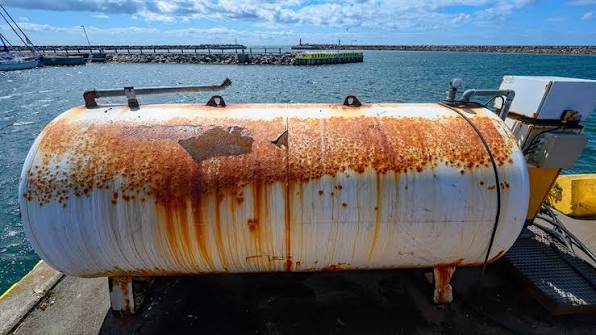
Coastal LPG corrosion Kenya is a significant engineering consideration for LPG installations exposed to salt-laden air, humidity and marine conditions. In Mombasa and other coastal areas, poor material selection, damaged protective coatings and inadequate maintenance can accelerate corrosion of tanks, pipework, supports, valves and associated safety equipment.
LPG itself is not normally the primary cause of external atmospheric corrosion on a storage tank.
Related Products
The surrounding environment is.
Coastal installations face a combination of:
- High humidity
- Salt particles
- Chlorides
- Condensation
- Persistent moisture
- Strong sunlight
- Rainfall
- Wind-driven salt spray
- Temperature variation
- Contaminated drainage areas
These conditions can create an aggressive atmospheric environment for exposed steel.
For a commercial or industrial LPG facility, corrosion is more than an appearance problem. Progressive material degradation can affect structural integrity, valve operation, pipe supports, protective coatings, identification markings and access to critical safety equipment.
A properly engineered Mombasa gas installation therefore requires corrosion control to be considered from design through commissioning, inspection and long-term maintenance.
What Is Coastal LPG Corrosion?
Coastal LPG corrosion is the degradation of exposed LPG installation components caused or accelerated by the marine environment, particularly moisture, oxygen and airborne chlorides. It can affect carbon-steel tanks, pipework, supports, valves, fasteners and protective coatings if the installation is not appropriately designed and maintained.
Corrosion is an electrochemical process.
For carbon steel, moisture provides an electrolyte while oxygen participates in the corrosion reaction. Chloride contamination from marine air can make the environment considerably more aggressive by supporting the electrochemical processes and contributing to breakdown of protective films and coatings.
The problem becomes more pronounced when salt deposits remain on surfaces.
A dry salt deposit may initially appear harmless.
Once moisture reaches it, however, the salt can dissolve and create a conductive electrolyte.
This means that a coastal LPG installation can experience corrosion even when it is not directly beside the ocean.
The distance from the shoreline matters, but so do:
- Wind direction
- Exposure
- Building configuration
- Local humidity
- Drainage
- Cleaning practices
- Vegetation
- Salt deposition
- Protective coating condition
This is why coastal LPG corrosion Kenya should be treated as an environmental design issue rather than simply a maintenance issue.
Why Mombasa LPG Installations Need Special Corrosion Protection
Mombasa’s coastal environment exposes outdoor LPG equipment to humid, salt-laden air that can accelerate atmospheric corrosion. The risk is particularly important for carbon-steel surfaces, support structures, fasteners, pipe brackets and areas where water and salt can accumulate.
A typical Mombasa gas installation may include:
- Bulk LPG storage tanks
- LPG cylinders
- Vapour lines
- Liquid lines
- Regulators
- Isolation valves
- Pressure-relief devices
- Filling connections
- Gas trains
- Pipe supports
- Tank saddles
- Platforms
- Ladders
- Electrical equipment
- Gas detection systems
- Fire protection equipment
Not all these components corrode at the same rate.
The most vulnerable locations are often those where moisture and contaminants remain trapped.
Examples include:
- Underside of pipework
- Tank support interfaces
- Bolted connections
- Valve bodies
- Flanges
- Coating defects
- Crevices
- Drain points
- Horizontal surfaces
- Areas beneath insulation
- Damaged painted surfaces
The objective is therefore not simply to specify a “corrosion-resistant tank.”
The entire installation must be designed for the environment.
How Salt Air Attacks LPG Equipment
Salt air increases corrosion risk because airborne chloride particles can settle on exposed metal surfaces and combine with moisture to form a conductive electrolyte. Repeated wetting and drying can concentrate salts, gradually weakening protective coatings and accelerating corrosion at exposed or damaged areas.
Marine corrosion commonly develops through a cycle.
Salt particles settle on the equipment.
Humidity or rain wets the deposits.
An electrolyte forms.
Electrochemical corrosion begins.
The surface subsequently dries.
Salt remains.
The cycle repeats.
Over time, protective coatings may develop:
- Blistering
- Peeling
- Cracking
- Discoloration
- Undercutting
- Localised failure
Once the coating is compromised, the underlying steel becomes exposed.
The corrosion process can then accelerate.
This is a key reason salt air corrosion tank problems should be identified before visible damage becomes severe.
Coastal LPG Corrosion and Carbon Steel
Carbon steel remains widely used for LPG storage vessels and industrial pipework because of its mechanical properties, availability and suitability for pressure-service applications. In coastal environments, however, carbon steel requires an appropriate protective coating system, inspection regime and drainage design to control external atmospheric corrosion.
Carbon steel is not inherently unsuitable for coastal LPG installations.
It simply requires protection.
For a bulk LPG tank, corrosion protection may involve:
- Surface preparation
- Primer
- Intermediate coating
- Protective topcoat
- Appropriate coating thickness
- Inspection
- Repair of coating damage
The exact coating specification should be selected according to:
- Environmental exposure
- Operating temperature
- Surface condition
- Manufacturer requirements
- Applicable standards
- Expected service life
A high-quality coating applied over poorly prepared steel can still fail prematurely.
Surface preparation is therefore fundamental.
Choosing Materials for Coastal LPG Installations
Material selection for coastal LPG installations should balance pressure-service requirements, mechanical strength, compatibility with LPG, corrosion resistance, availability and maintainability. Carbon steel can be appropriate for major LPG components when correctly protected, while stainless steel, suitable non-metallic materials and corrosion-resistant fittings may be appropriate for selected components.
The correct material depends on the component.
A storage tank has different requirements from:
- Instrument tubing
- Pipe supports
- Fasteners
- Valves
- Electrical enclosures
- Gas detectors
- Drainage components
Engineers should avoid specifying one material for everything.
A practical material strategy may include:
| Component | Typical Material Consideration | Coastal Protection Requirement |
|---|---|---|
| LPG storage vessel | Carbon steel pressure vessel | Robust external coating and inspection |
| LPG pipework | Carbon steel or approved LPG-rated piping | External corrosion protection |
| Valve bodies | Approved LPG-compatible material | Protective finish where required |
| Fasteners | Corrosion-resistant specification | High priority in exposed areas |
| Pipe supports | Galvanised/coated steel or suitable alternative | Prevent water traps |
| Instrumentation | Manufacturer-approved materials | Weatherproof enclosure |
| Electrical equipment | Suitable enclosure/environmental rating | Protect against moisture and salt |
| Detection equipment | Manufacturer-approved construction | Routine functional inspection |
| Tank supports | Structural steel | Coating and drainage |
| Labels/signage | UV and weather-resistant material | Regular replacement |
The table is a design framework, not a substitute for component-specific specifications.
Stainless Steel in Coastal LPG Systems
Stainless steel can provide excellent resistance to atmospheric corrosion in many coastal applications, but stainless steel is not automatically immune to chloride-related corrosion. The grade, surface condition, fabrication method, crevice exposure and environmental severity should all be considered before selecting it for a coastal LPG installation.
A common misconception is:
“Stainless steel cannot rust.”
That is incorrect.
Certain stainless-steel grades can suffer:
- Pitting corrosion
- Crevice corrosion
- Chloride stress-corrosion cracking under specific conditions
The appropriate grade therefore depends on the service environment.
Stainless steel can be useful for selected:
- Instrumentation
- Small-bore tubing
- Fasteners
- Components
- Equipment enclosures
However, using stainless steel everywhere may not be economically justified.
The better approach is engineering-based material selection.
Galvanised Steel and Coastal Exposure
Galvanised steel can provide useful corrosion protection by applying a zinc coating over steel, but the durability of galvanising depends on coating thickness, environmental exposure, damage and the local corrosion rate. Coastal installations should inspect galvanised components regularly, especially where salt deposits and standing moisture occur.
Galvanised components can be useful for:
- Supports
- Brackets
- Guard structures
- Certain ancillary components
However, galvanising can deteriorate.
Common problem areas include:
- Cut edges
- Welded areas
- Scratches
- Bolted interfaces
- Areas where water collects
If a galvanised component is cut or welded after galvanising, the exposed area may require suitable corrosion protection.
Protective Coatings for LPG Tanks
Protective coatings are one of the primary methods of controlling external corrosion on carbon-steel LPG tanks. A coastal coating system should be selected according to environmental exposure and applied over correctly prepared steel, with coating thickness, adhesion and defects inspected before the tank enters service.
The coating system typically has multiple functions.
The primer provides adhesion and corrosion protection.
The intermediate coat provides additional barrier thickness.
The topcoat provides environmental and UV protection.
For a coastal salt air corrosion tank application, the coating system should be selected according to the expected atmospheric corrosivity and manufacturer or engineer specification.
A coating system is only effective when correctly applied.
Critical factors include:
- Surface cleanliness
- Surface profile
- Ambient humidity
- Steel temperature
- Application method
- Dry-film thickness
- Recoat interval
- Curing
- Holiday detection where applicable
Tank Surface Preparation
Surface preparation is one of the most important stages of tank corrosion protection. Rust, mill scale, oil, salt contamination and other contaminants must be appropriately removed before coating because residual contamination can undermine adhesion and allow corrosion to develop beneath the protective system.
For coastal tanks, salt contamination deserves particular attention.
A surface can appear visually clean while still containing soluble salts.
If these remain beneath a coating, moisture can later activate them.
A professional coating programme should therefore specify:
- Cleaning method
- Surface preparation standard
- Salt-contamination control
- Surface profile
- Environmental conditions
- Primer specification
- Coating thickness
This is an area where shortcuts can substantially reduce coating life.
Corrosion Under LPG Tank Supports
Tank supports and support-to-vessel interfaces require special attention because they can trap moisture and salt deposits. Corrosion at these locations can remain hidden from routine visual inspection, making support interfaces important areas in a coastal LPG inspection programme.
Bulk LPG tanks are commonly supported using structural arrangements designed to transfer vessel loads safely to foundations.
The support area can become a corrosion concern if:
- Water accumulates.
- Coating is damaged.
- Salt deposits remain.
- Drainage is poor.
- Inspection access is limited.
An engineer should inspect:
- Tank support connections
- Welded areas
- Saddles
- Base plates
- Anchor bolts
- Foundation interfaces
The inspection should determine whether corrosion is superficial or whether metal loss could affect structural integrity.
LPG Pipework in Coastal Environments
LPG pipework installed outdoors in coastal areas requires protection against atmospheric corrosion, particularly at supports, joints, valves, flanges and coating defects. Pipe routing should minimise water traps and provide sufficient access for inspection, painting and maintenance.
Pipework design should consider:
- Material
- Wall thickness
- Pressure rating
- Coating
- Supports
- Drainage
- Expansion
- Accessibility
- Isolation points
Horizontal pipe runs should not create unnecessary pockets where water can accumulate.
Supports should also be designed so that they do not damage the protective coating.
Where an LPG pipe penetrates a support, corrosion protection must remain continuous.
Flanges and Bolted LPG Connections
Flanges and bolted connections can become corrosion hotspots in marine environments because they contain crevices, dissimilar surfaces and areas where salt and moisture can accumulate. Regular inspection should focus on flange edges, bolts, nuts, washers and coating condition.
Corrosion around a flange may be more significant than corrosion on an open pipe surface.
This is because:
- Crevices retain moisture.
- Salt can accumulate.
- Coating access is restricted.
- Bolts can corrode faster than protected pipe surfaces.
Fastener selection should therefore form part of the coastal corrosion strategy.
Replacing heavily corroded bolts is not simply cosmetic.
The engineer should assess whether corrosion has affected:
- Mechanical integrity
- Valve operation
- Flange loading
- Connection reliability
LPG Valves and Corrosion
LPG valves must remain mechanically operable and leak-tight throughout their service life. Coastal corrosion can affect valve bodies, stems, handles, bolts and external mechanisms, so valves should be inspected and exercised according to the equipment manufacturer’s requirements and the installation’s maintenance programme.
A valve may appear functional but have internal or external corrosion.
Potential issues include:
- Seized stems
- Corroded handles
- Damaged identification
- External pitting
- Flange corrosion
- Seal degradation
Emergency isolation valves deserve particularly high attention.
A safety valve that cannot be operated when needed defeats its intended purpose.
LPG Pressure Relief Devices
Pressure relief devices are critical safety components and must remain suitable, unobstructed and properly maintained. Corrosion can affect external components, discharge arrangements and associated connections, so inspection should verify that relief-device installations remain compliant with applicable requirements and manufacturer specifications.
Relief devices should never be painted or modified in a manner that interferes with their operation unless specifically permitted by the manufacturer and applicable requirements.
Inspectors should check for:
- Corrosion
- Blockage
- Physical damage
- Incorrect discharge arrangements
- Tampering
- Obstruction
Because pressure-relief devices are safety-critical, maintenance should follow applicable codes, regulations and manufacturer instructions.
Coastal LPG Leak Detection
Salt and humidity can affect electrical and electronic equipment used in LPG safety systems. Gas detectors, control panels and associated wiring should therefore be selected for their environmental conditions and maintained to ensure that corrosion, moisture ingress or salt contamination does not compromise detection performance.
A coastal LPG installation may use:
- Gas detectors
- Alarm panels
- Emergency shut-off systems
- Solenoid valves
- Control systems
For industrial applications, industrial gas leak detection can be incorporated into a broader gas safety system.
Equipment should be installed according to the manufacturer’s environmental requirements.
Where coastal exposure is severe, enclosure protection and mounting location become important design considerations.
Electrical Equipment Around LPG Installations
Electrical equipment serving LPG installations must be appropriate for the hazardous-area classification and environmental conditions of the site. Coastal exposure adds moisture and salt contamination to the design problem, so equipment enclosures, cable entries, glands and mounting arrangements require careful specification and maintenance.
The engineer should consider:
- Hazardous-area classification
- Enclosure protection
- Corrosion resistance
- Cable-gland suitability
- UV exposure
- Salt exposure
- Condensation
- Maintenance access
The environmental protection requirement should not be confused with hazardous-area certification.
A weather-resistant enclosure does not automatically make electrical equipment suitable for a hazardous LPG area.
Both requirements must be addressed.
Fire Protection for Coastal LPG Installations
Coastal corrosion protection must extend to fire-safety equipment because extinguishers, hydrants, valves, fire cabinets, detectors and suppression components can also deteriorate in salt-laden environments. Fire equipment must remain accessible, identifiable and operational throughout the installation’s service life.
A coastal LPG site may include:
- Fire extinguishers
- Fire hose systems
- Hydrants
- Fire-water systems
- Emergency shutdowns
- Gas detectors
- Fire alarms
- Fixed suppression systems
Corrosion can affect:
- Cylinder bodies
- Valve assemblies
- Hose connections
- Fire-water pipework
- Cabinet hinges
- Mounting brackets
- Signage
Megtraco’s fire suppression equipment can form part of an integrated fire-protection strategy.
Corrosion and LPG Cylinder Storage
LPG cylinders stored in coastal environments should be protected from prolonged exposure to corrosive conditions while maintaining ventilation, access and safe separation. Cylinders should be inspected for excessive corrosion, dents, damaged valves, defective fittings and compromised identification before use.
Cylinder storage areas should be:
- Well ventilated
- Properly organised
- Protected from physical damage
- Kept free from unnecessary moisture accumulation
- Accessible for inspection
A cylinder with serious corrosion should not simply be repainted and returned to service without appropriate assessment.
Pressure vessels require controlled inspection and compliance with applicable requirements.
Coastal LPG Maintenance Programme
A coastal LPG maintenance programme should be more proactive than a routine visual check. Inspections should identify coating breakdown, pitting, salt accumulation, support corrosion, valve deterioration and damage to safety equipment before degradation becomes a structural or operational problem.
A useful inspection framework includes:
| Inspection Area | What to Check | Recommended Action |
|---|---|---|
| LPG tank | Coating, rust, pitting | Repair and assess metal loss |
| Tank supports | Rust, cracks, water traps | Clean, repair and protect |
| Pipework | Coating and pitting | Repair coating and investigate metal loss |
| Valves | Corrosion and operation | Service or replace as required |
| Flanges | Bolts, nuts, corrosion | Inspect connection integrity |
| Pressure relief devices | Damage, corrosion, obstruction | Maintain according to requirements |
| Gas detectors | Housing and function | Test and service |
| Fire equipment | Corrosion and accessibility | Service or replace |
| Signage | Legibility and UV damage | Replace |
| Foundations | Cracking and drainage | Repair drainage/structure |
| Electrical equipment | Moisture and corrosion | Inspect enclosure and connections |
The inspection frequency should be determined according to the installation, environmental exposure, equipment manufacturer’s requirements and applicable regulatory obligations.
Cleaning Salt From LPG Equipment
Removing accumulated salt deposits can reduce the amount of chloride available to participate in corrosion, but cleaning must be performed without damaging protective coatings, electrical equipment, valves or LPG-system components. Coastal installations should have a controlled cleaning procedure rather than relying on occasional cosmetic washing.
Cleaning should address:
- Tank surfaces
- Pipework
- Supports
- Valve exteriors
- Platforms
- Handrails
- Fire equipment
- Electrical enclosures
After cleaning, surfaces should be allowed to dry appropriately.
Damaged coatings identified during cleaning should be repaired promptly.
Simply washing salt away without restoring damaged coatings may only provide temporary improvement.
Detecting Early Corrosion
Early corrosion is easier and less expensive to control than advanced metal loss. Coastal LPG inspections should therefore look for coating discoloration, blistering, rust staining, pitting, flaking, salt deposits and corrosion around supports and joints before these conditions develop into significant material degradation.
Early warning signs include:
- Small rust spots
- Brown staining
- Coating bubbles
- Peeling paint
- White corrosion products on galvanised steel
- Pitting
- Flaking
- Cracked coatings
- Corroded bolts
A useful maintenance rule is:
Do not wait for deep rust before taking action.
Measuring LPG Tank Corrosion
Visual inspection can identify obvious corrosion, but suspected material loss may require thickness measurement or other non-destructive examination. The appropriate inspection technique and acceptance criteria should be determined by a competent engineer or qualified inspection professional based on the tank design, service history and applicable requirements.
Depending on the situation, inspection may involve:
- Visual examination
- Ultrasonic thickness measurement
- Coating inspection
- Weld inspection
- Non-destructive testing
- Internal examination where required
The objective is to determine:
How much material has been lost?
and
Does the remaining thickness remain suitable for service?
This is especially important when corrosion is widespread or concentrated in structural areas.
Corrosion Under Insulation
Where LPG-related process equipment or associated piping is insulated for a legitimate engineering purpose, moisture trapped beneath insulation can create a concealed corrosion environment. Coastal exposure increases the importance of controlling water ingress and inspecting insulation systems where corrosion under insulation is credible.
Insulation should not be applied without considering:
- Moisture ingress
- Vapour barriers
- Drainage
- Inspection access
- Temperature requirements
Where insulation is unnecessary, avoiding it can simplify inspection and reduce hidden corrosion risks.
Drainage Around LPG Tanks
Effective drainage is a simple but important corrosion-control measure because standing water increases the duration of wet exposure. LPG tank foundations, supports and surrounding surfaces should be arranged to prevent water from remaining around vulnerable steel components.
Drainage should prevent:
- Ponding
- Water accumulation under supports
- Persistent wet areas
- Blocked access routes
Coastal sites should be inspected after heavy rainfall to identify areas where water remains.
A drainage problem can turn a manageable coating defect into a persistent corrosion problem.
Coating Inspection and Repair
Coatings should be treated as engineered protective systems rather than decorative paint. Inspection should verify coating condition and identify damaged areas, while repairs should follow the original coating specification or an approved compatible repair system.
Common coating failures include:
- Blistering
- Peeling
- Cracking
- Chalking
- Rust creep
- Undercutting
- Mechanical damage
When repairs are performed, compatibility between the existing and new coating systems matters.
Simply applying a new coat over loose or contaminated old paint can trap defects underneath.
Coastal LPG Installation Commissioning
Corrosion protection should be verified before a new coastal LPG installation is commissioned. The inspection should confirm that tank coatings, pipe protection, supports, valves, safety equipment, drainage and identification systems are complete and suitable for the environmental exposure.
Commissioning should include appropriate verification of:
- LPG pressure systems
- Pipework
- Leak tightness
- Valves
- Emergency isolation
- Gas detection
- Fire protection
- Electrical systems
- Coating condition
- Documentation
EPRA’s LPG installation guidance provides requirements relevant to inspection, testing and commissioning of LPG systems in Kenya.
The corrosion-control programme should then continue after commissioning.
Corrosion prevention is not a one-time installation activity.
EPRA, KEBS and Coastal LPG Compliance
A coastal LPG installation must comply with applicable Kenyan regulatory and standards requirements in addition to sound corrosion-engineering practice. EPRA requirements govern relevant LPG installation activities, while KEBS standards and conformity requirements provide important controls for products, equipment and technical quality.
EPRA’s published LPG installer guidance covers the planning, design, construction, commissioning, operation and maintenance of LPG installations and reticulation systems.
KEBS provides Kenya’s standards framework and conformity-assessment mechanisms, including standards applicable to products and technical services.
For a Mombasa gas installation, compliance should therefore be evaluated alongside environmental exposure.
Meeting a minimum regulatory requirement does not eliminate the need for a corrosion-management programme.
Designing a Corrosion-Resistant Mombasa Gas Installation
A corrosion-resistant Mombasa gas installation combines appropriate pressure-service materials with protective coatings, effective drainage, suitable supports, environmental protection for electrical equipment and a planned inspection programme. The best results come from addressing corrosion during design rather than attempting to correct it after installation.
The design process should consider:
Site conditions
- Distance from coast
- Salt exposure
- Humidity
- Rainfall
- Wind direction
Equipment
- Tank material
- Pipe material
- Valve materials
- Fasteners
- Supports
- Electrical enclosures
Protection
- Coating system
- Galvanising
- Drainage
- Sealing
- Equipment placement
Maintenance
- Inspection access
- Cleaning
- Coating repair
- Thickness monitoring
- Replacement strategy
This approach reduces lifecycle costs.
Coastal LPG Corrosion vs Inland LPG Corrosion
The fundamental LPG safety requirements remain the same inland and at the coast, but coastal environments generally impose greater atmospheric corrosion challenges. An installation near Mombasa therefore needs the same core LPG engineering discipline plus stronger consideration of salt exposure, coating durability, moisture management and corrosion inspection.
| Factor | Inland Installation | Coastal Installation |
|---|---|---|
| Salt exposure | Generally lower | Higher |
| Humidity | Site dependent | Generally higher |
| Chloride contamination | Lower | Higher |
| Coating demand | Standard environmental assessment | More demanding |
| Fastener corrosion | Moderate/site dependent | Higher concern |
| Support corrosion | Site dependent | Higher concern |
| Cleaning requirement | Routine | More frequent where salt deposits accumulate |
| Inspection focus | General corrosion | Corrosion plus marine exposure |
| Drainage importance | High | Very high |
| Coating maintenance | Important | Critical |
This does not mean inland installations can ignore corrosion.
It means coastal installations require a more deliberate corrosion strategy.
Common Coastal LPG Corrosion Mistakes
Many coastal LPG corrosion problems arise from preventable design and maintenance errors rather than unavoidable environmental damage. Common mistakes include inadequate surface preparation, poor drainage, incompatible materials, damaged coatings, inaccessible supports and failure to inspect corrosion-prone areas regularly.
Common errors include:
Using ordinary paint without a coating specification
Decorative paint is not necessarily a suitable industrial corrosion-protection system.
Ignoring salt contamination
Salt remaining beneath a coating can contribute to premature coating failure.
Allowing water to collect around supports
Standing water increases corrosion exposure.
Using unsuitable fasteners
Fasteners can become corrosion hotspots even when the surrounding pipework remains protected.
Painting over active rust
This can conceal rather than solve corrosion.
Ignoring small coating defects
Small defects can become larger corrosion sites.
Failing to inspect hidden areas
Corrosion often develops where access is difficult.
Long-Term Coastal LPG Maintenance Strategy
The most effective coastal LPG maintenance programme combines routine visual inspection, cleaning, coating repair, functional testing and periodic engineering assessment. Maintenance records should identify corrosion trends so that components can be repaired or replaced before their condition threatens safety or operational continuity.
A long-term programme should include:
- Baseline inspection
- Scheduled visual inspections
- Coating assessment
- Salt-deposit cleaning
- Valve inspection
- Pipework inspection
- Support inspection
- Fire-system inspection
- Gas detection testing
- Thickness monitoring where required
- Documentation
- Corrective maintenance
A baseline record is particularly valuable.
Photographs and inspection measurements can be compared over time.
This allows engineers to determine whether corrosion is:
- Stable
- Progressing slowly
- Progressing rapidly
When Coastal LPG Equipment Should Be Replaced
Replacement should be based on engineering condition rather than appearance alone. Equipment may require replacement when corrosion has caused unacceptable material loss, compromised pressure integrity, affected safety-critical operation or exceeded applicable inspection and acceptance criteria.
Replacement may be appropriate for:
- Severely corroded valves
- Damaged pipe sections
- Failed supports
- Corroded fasteners
- Severely degraded fire equipment
- Damaged detectors
- Compromised electrical enclosures
- LPG cylinders that fail applicable inspection requirements
For pressure-containing equipment, decisions should be made by competent professionals using the applicable design and inspection requirements.
Frequently Asked Questions
What causes coastal LPG corrosion in Kenya?
Coastal LPG corrosion Kenya is primarily associated with atmospheric exposure to moisture, oxygen and airborne chlorides. Salt deposits can accelerate corrosion of exposed carbon steel, supports, fasteners, valves and damaged coating areas, particularly when moisture remains on surfaces.
Is Mombasa too corrosive for carbon-steel LPG tanks?
No. Carbon-steel LPG tanks can be used successfully in coastal environments when correctly designed, coated, installed, inspected and maintained. The key is an appropriate corrosion-protection system rather than assuming carbon steel is unsuitable for coastal service.
How does salt air affect an LPG tank?
Salt particles settle on the tank surface and can combine with moisture to create a conductive electrolyte that accelerates atmospheric corrosion. Damaged coatings can expose the steel underneath, allowing corrosion to progress and potentially cause material loss over time.
What is the best material for a coastal LPG installation?
There is no single best material for every LPG component. Carbon steel can be appropriate for pressure vessels and pipework when properly protected, while stainless steel, galvanised steel or other approved materials may be appropriate for selected components depending on service and environmental conditions.
Does stainless steel prevent coastal corrosion?
Stainless steel offers strong corrosion resistance but is not completely immune to marine corrosion. Chlorides can cause pitting or crevice corrosion in susceptible grades and conditions, so grade selection and installation details remain important.
How often should a coastal LPG installation be inspected?
Inspection frequency should be determined according to the equipment, environmental exposure, manufacturer requirements, applicable standards and regulatory requirements. Coastal installations generally benefit from proactive corrosion inspections rather than relying only on infrequent general maintenance.
How can salt air corrosion on LPG tanks be prevented?
Effective prevention combines suitable surface preparation, an engineered protective coating system, drainage, regular cleaning, coating inspection, prompt repair of damaged areas and periodic assessment of metal condition where corrosion is suspected.
Can a corroded LPG tank simply be repainted?
Not necessarily. Repainting may be appropriate for superficial coating deterioration, but significant corrosion requires assessment of the remaining material thickness and structural condition before a repair or coating programme is approved.
Why do LPG pipe supports corrode faster at the coast?
Pipe supports can trap moisture and salt deposits while also creating coating-damage points. Crevices and poorly drained interfaces can remain wet longer than exposed pipe surfaces, increasing the risk of localised corrosion.
What should be checked during coastal LPG maintenance?
Maintenance should check tank coatings, pipework, supports, valves, flanges, fasteners, pressure-relief devices, gas detectors, electrical equipment, fire protection, drainage and other corrosion-prone components.
Is Mombasa LPG maintenance different from Nairobi maintenance?
The core LPG safety requirements remain applicable in both locations, but Mombasa installations require greater attention to salt exposure, humidity, coating condition, fasteners, drainage and marine-environment corrosion.
Does coastal corrosion affect LPG safety?
Yes. Severe corrosion can compromise structural components, pressure-containing equipment, valves, supports and safety systems. Early detection and appropriate corrective action help prevent corrosion from developing into a safety-critical failure.
Can corrosion affect LPG valves?
Yes. External corrosion can affect valve bodies, stems, handles, fasteners and connections. Valves should remain accessible, operable and leak-tight, with inspection and maintenance performed according to applicable requirements.
Does coastal corrosion affect fire equipment?
Yes. Salt and moisture can corrode extinguishers, fire-water components, cabinets, valves, brackets and other fire-protection equipment. Fire equipment at coastal LPG facilities therefore requires its own corrosion inspection and maintenance programme.
Engineering Conclusion
A reliable coastal LPG installation requires corrosion engineering to be integrated into material selection, tank protection, pipework design, drainage, equipment specification, commissioning and maintenance. For Mombasa and the Kenyan coast, controlling salt exposure and monitoring corrosion are essential to protecting LPG infrastructure and maintaining safe long-term operation.
The most important lesson is that coastal corrosion should be managed before it becomes visible damage.
A successful coastal LPG corrosion Kenya strategy starts during design.
It considers the marine environment before selecting:
- Tank coatings
- Pipe materials
- Supports
- Fasteners
- Valves
- Electrical equipment
- Fire equipment
It continues through installation by ensuring:
- Correct surface preparation
- Proper coating application
- Good drainage
- Accessible equipment
- Appropriate component selection
And it continues throughout the operating life through:
- Routine inspections
- Cleaning
- Coating repairs
- Thickness monitoring
- Functional testing
- Preventive replacement
For a Mombasa gas installation, corrosion protection is therefore not an optional cosmetic upgrade. It is part of responsible asset management.
The goal is not simply to make the LPG equipment look clean.
The goal is to preserve:
pressure integrity, mechanical strength, valve operation, safety-system reliability and long-term serviceability.
Megtraco Kenya Ltd can support LPG projects requiring engineered equipment, reticulation, safety systems and professional technical assessment. For projects requiring our LPG engineering solutions, corrosion exposure should be included in the design brief from the beginning.
A properly engineered coastal installation can operate reliably for many years.
The difference is disciplined material selection, appropriate protection and consistent maintenance.
Your Trusted LPG & Fire Safety Engineering Partner in East Africa
Whether you’re designing a new LPG installation, upgrading industrial gas systems, or enhancing fire safety compliance, Megtraco Kenya Ltd delivers certified engineering solutions backed by decades of expertise. From LPG equipment supply and pipeline installations to fire suppression and detection systems, our experienced team provides reliable solutions for commercial, industrial, and institutional projects across East Africa.
Contact us today for professional consultation, engineering support, or a customized quotation.
WHY CHOOSE MEGTRACO KENYA LTD
You May Also Like
- ✔ Established Since 1969 – Decades of proven engineering excellence.
- ✔ KEBS Certified Products – Guaranteed quality and compliance with regional standards.
- ✔ EPRA Licensed LPG Engineering Company – Fully certified to design, install, and commission.
- ✔ Industrial & Commercial LPG Specialists – Scaled to handle heavy-duty thermal requirements.
- ✔ Fire Suppression & Fire Detection Experts – End-to-end asset protection.
- ✔ Regional Operational Footprint – Serving Nairobi, Mombasa, Kisumu, Nakuru, Eldoret, Thika, Machakos, East Africa, and beyond.
Contact Megtraco Kenya Ltd
- Email: sales@megtracokenya.com
- Sales: +254 725 870 114
- Technical: +254 733 721 598
- WhatsApp: +254 799 086 323
- Location: Nairobi, Kenya – Serving East Africa
- Website: https://megtracokenya.com
Request a Quote today and partner with East Africa’s trusted LPG and fire safety engineering company since 1969
