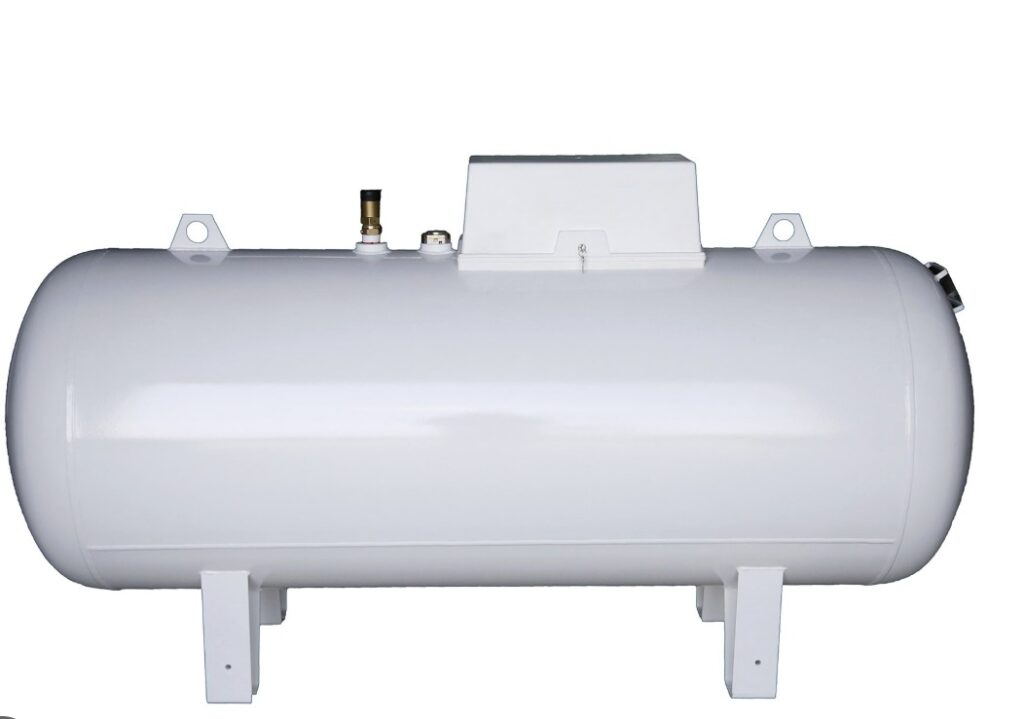
LPG tank sizing in Kenya should be based on actual consumption, delivery frequency, usable storage capacity and the required safety stock—not simply on the size of the LPG installation or the available space on site. A correctly sized tank provides sufficient fuel between deliveries while maintaining an appropriate operating reserve and avoiding unnecessary capital tied up in excess storage.
For an industrial or commercial facility, the central question is:
Related Products
How much LPG must the storage system hold to safely cover the period between deliveries?
That answer depends on several variables:
- Average LPG consumption
- Peak LPG consumption
- Delivery lead time
- Supplier delivery frequency
- Minimum operating reserve
- Tank filling limits
- Seasonal demand
- Production schedules
- Emergency supply arrangements
- Future expansion
A facility consuming 10 tonnes of LPG per month does not automatically require a 10-tonne storage tank. Conversely, a 10-tonne tank may be inadequate if the supplier can only deliver every three weeks and the plant experiences significant production peaks.
The engineering objective is to match storage capacity with the site’s actual consumption and replenishment cycle.
Why Bulk LPG Tank Sizing Matters
Correct tank sizing balances fuel availability, safety, capital cost and delivery logistics. An undersized tank can cause production interruptions and emergency deliveries, while an oversized tank can increase capital expenditure and leave the facility carrying unnecessary stored inventory.
A bulk LPG tank is part of a larger fuel-supply system.
Its capacity affects:
- Delivery frequency
- Vehicle access
- Supplier logistics
- Working capital
- Vaporization capacity
- Pressure stability
- Site layout
- Fire-safety planning
- Future expansion
Tank sizing should therefore be completed before the final storage arrangement, vaporizer selection and associated LPG piping are designed.
For industrial facilities, Megtraco’s industrial LPG equipment can be selected around the calculated demand rather than using a one-size-fits-all approach.
What Is the Correct Size for a Bulk LPG Tank?
The correct LPG tank size is the capacity that provides adequate usable LPG between planned deliveries while retaining the required reserve and respecting the permitted filling level. The nominal water capacity of a tank is not the same as the quantity of LPG that can safely be stored in normal operation.
This distinction is essential.
LPG storage tanks are generally described using water capacity, such as:
- 1,000 litres water capacity
- 2,000 litres water capacity
- 5,000 litres water capacity
- 10,000 litres water capacity
- 20,000 litres water capacity
- Larger industrial vessels
However, the actual LPG inventory is lower than the tank’s nominal water capacity.
The conversion depends on the LPG density and the applicable filling requirements.
For this reason, an engineer should not calculate storage simply by saying:
“The plant uses 5,000 litres of LPG, so install a 5,000-litre tank.”
The calculation needs to distinguish between:
Tank water capacity → allowable filling level → LPG inventory → usable operating inventory.
Start With Actual LPG Consumption
The most important input in bulk LPG tank sizing is the facility’s actual consumption history. Supplier invoices, LPG delivery records, flow measurements and production data provide a much stronger basis than estimating consumption from equipment nameplates alone.
A good assessment should ideally review at least several months of:
- LPG delivery quantities
- Delivery dates
- Production volumes
- Operating hours
- Seasonal demand
- Peak production periods
- Equipment operating schedules
For an existing facility, the most reliable starting point is often the supplier delivery history.
For example, suppose a factory receives:
| Month | LPG Delivered |
|---|---|
| January | 8,200 kg |
| February | 8,600 kg |
| March | 8,450 kg |
| April | 9,100 kg |
| May | 9,400 kg |
| June | 9,250 kg |
Average consumption is approximately:
8,833 kg/month
But the engineer should not automatically size the tank around the average.
The highest monthly demand may be more important for ensuring continuity of supply.
Average Consumption vs Peak Consumption
Average consumption is useful for estimating normal inventory requirements, but peak consumption is essential for checking whether the storage system can withstand periods of increased production. A tank sized solely around average demand may leave too little reserve during high-consumption periods.
Industrial LPG consumption can increase because of:
- Higher production
- Additional shifts
- Seasonal processing
- New equipment
- Increased boiler demand
- Larger hotel occupancy
- Agricultural processing seasons
- Temporary production campaigns
For example:
A plant normally consumes:
9 tonnes/month
But during peak production:
12 tonnes/month
Using only 9 tonnes/month for storage planning could result in a tank that appears adequate under normal conditions but becomes difficult to manage during peak periods.
The storage model should therefore consider both normal demand and peak demand.
How Delivery Lead Time Changes Tank Size
Delivery lead time is one of the most important factors in LPG tank sizing because the storage system must carry the facility through the period before the next reliable delivery can arrive. A plant with same-week delivery access may require less storage than an isolated facility dependent on scheduled deliveries.
Consider two factories with identical consumption:
Factory A
- Consumption: 10 tonnes/month
- Supplier delivery: every 7 days
- Reliable logistics
- Short replenishment lead time
Factory B
- Consumption: 10 tonnes/month
- Supplier delivery: every 21 days
- Longer transport distance
- Limited delivery flexibility
Factory B requires significantly more storage resilience.
This is why the question “How big should my LPG tank be?” cannot be answered from consumption alone.
The correct question is:
“How much LPG must remain available until the next dependable replenishment opportunity?”
Calculating Daily LPG Consumption
Daily consumption converts monthly fuel demand into a value that can be matched against delivery lead time and safety stock. It is one of the simplest and most useful calculations in preliminary tank sizing.
Suppose the plant consumes:
9,000 kg/month
Assuming 30 days:
9,000 ÷ 30 = 300 kg/day
If the delivery lead time is 10 days:
300 × 10 = 3,000 kg
The facility therefore needs approximately 3 tonnes of LPG to cover ten days of average consumption.
But that does not necessarily mean a 3-tonne LPG tank is appropriate.
A reserve must also be considered.
Adding Safety Stock to the Calculation
Safety stock provides additional inventory beyond the expected consumption during normal delivery lead time. It protects the facility against delayed deliveries, unexpected consumption increases and temporary supply disruptions.
A simplified calculation is:
Required LPG inventory = Lead-time demand + Safety stock
For example:
Daily consumption:
300 kg/day
Delivery lead time:
10 days
Lead-time demand:
300 × 10 = 3,000 kg
Suppose the facility requires an additional 5 days of safety stock:
300 × 5 = 1,500 kg
Total required usable inventory:
3,000 + 1,500 = 4,500 kg
The tank therefore needs to provide at least approximately 4.5 tonnes of usable LPG inventory under the assumptions used.
The final tank selection must then account for the permitted maximum filling level and the physical characteristics of the selected vessel.
Worked LPG Tank Sizing Example
A practical tank-sizing calculation combines daily consumption, delivery lead time, safety stock and usable tank capacity. The following example demonstrates the method rather than specifying a universal tank size.
Assume an industrial facility has:
- Monthly LPG consumption: 12,000 kg
- Average daily consumption: 400 kg/day
- Delivery lead time: 10 days
- Safety stock: 5 days
- Peak consumption allowance: 15%
Step One: Calculate Lead-Time Demand
400 kg/day × 10 days = 4,000 kg
Step Two: Calculate Safety Stock
400 kg/day × 5 days = 2,000 kg
Step Three: Add the Two Requirements
4,000 + 2,000 = 6,000 kg
The facility therefore needs approximately:
6 tonnes of usable LPG inventory
Step Four: Add Peak-Demand Consideration
If the engineering assessment applies a 15% planning allowance:
6,000 × 1.15 = 6,900 kg
The target becomes approximately:
6.9 tonnes of usable LPG
The engineer would then select a suitable tank whose permitted operating inventory can accommodate that requirement.
The final vessel cannot simply be selected as a “6,900 kg tank.” Tank manufacturers commonly specify vessels by water capacity, while LPG storage is constrained by filling limits and operating requirements.
Understanding LPG Tank Water Capacity
Water capacity is the nominal internal volume of an LPG vessel measured using water, while LPG inventory represents the mass of LPG actually stored. The two values should never be treated as interchangeable when selecting an industrial tank.
A tank might therefore be described by:
- Water capacity
- LPG capacity
- Maximum permitted filling level
- Tare weight
- Design pressure
- Test pressure
- Operating temperature range
For preliminary calculations, an approximate LPG capacity can be estimated from the vessel’s water capacity and the density of LPG, but final sizing should use the manufacturer’s certified data and applicable standards.
This is particularly important because LPG expands with temperature.
The storage vessel therefore requires adequate vapour space rather than being filled completely with liquid.
Why LPG Tanks Are Not Filled to 100%
Bulk LPG vessels require vapour space because liquid LPG expands as its temperature rises. The allowable filling level is therefore controlled to prevent dangerous hydraulic expansion and excessive pressure conditions.
A storage tank should never be treated like a conventional water tank that can simply be filled to its geometric capacity.
The permitted filling level depends on:
- LPG composition
- Temperature
- Tank design
- Applicable regulations
- Applicable standards
- Installation conditions
This is one reason tank sizing should be performed by a competent LPG engineer.
Kenya’s LPG regulatory framework includes requirements for storage installations and safety arrangements, while applicable KEBS standards provide technical requirements for LPG storage and installations.
EPRA’s published LPG installer guidance addresses planning, design, construction, commissioning, operation and maintenance of LPG storage and associated equipment.
How Often Should an LPG Tank Be Refilled?
Refilling frequency should be determined by consumption, usable tank inventory and the supplier’s delivery cycle rather than by a fixed calendar interval. Many industrial facilities use planned reorder points so that replenishment begins before the tank approaches its minimum operating level.
A simple inventory strategy might use:
Reorder point = Expected consumption during supplier lead time + safety reserve
For example:
Daily demand:
400 kg
Lead time:
10 days
Safety stock:
2,000 kg
Reorder point:
4,000 + 2,000 = 6,000 kg
When the inventory approaches that threshold, the facility should initiate replenishment.
Actual alarm and reorder levels should be established around the characteristics of the selected tank, instrumentation and supplier logistics.
LPG Tank Size and Vaporizer Capacity Are Different Calculations
A storage tank determines how much LPG can be held, while a vaporizer determines how quickly liquid LPG can be converted into vapour for high-demand applications. A sufficiently large tank can still perform poorly if the vaporization system cannot satisfy peak burner demand.
Consider a factory requiring:
500 kg/hour of LPG
The storage tank must hold enough fuel to support the delivery cycle.
The vaporizer must also be capable of delivering the required gas flow.
These are two separate engineering questions.
Storage question
How many kilograms of LPG must be available?
Vaporization question
How many kilograms per hour must be converted into vapour?
A high-capacity industrial installation may therefore require:
- Bulk LPG storage
- Vaporizer
- Gas train
- Pressure regulation
- Burner controls
- Emergency isolation
- Leak detection
Megtraco provides LPG vaporizer solutions for applications where natural vaporization is insufficient for the required process demand.
Sizing the Vaporizer for Peak Load
Vaporizer capacity should be based on the maximum required LPG mass flow, operating conditions and appropriate engineering margins rather than simply the average daily consumption. The vaporizer must be capable of meeting peak simultaneous burner demand while maintaining stable downstream pressure.
For example, a facility may have:
- Boiler burner: 300 kg/h
- Oven burner: 120 kg/h
- Dryer burner: 80 kg/h
Total connected demand:
500 kg/h
But if the equipment does not always operate simultaneously, the engineer may apply an appropriate diversity factor based on the actual process.
This is why burner scheduling and production data matter.
Oversizing can increase capital expenditure and may affect turndown performance.
Undersizing can cause:
- Pressure instability
- Burner trips
- Production interruptions
- Poor combustion
- Increased operational risk
Bulk LPG Tank Sizing and Gas Consumption
LPG tank sizing should ultimately be connected to the gas consumption profile of every major appliance supplied by the installation. This requires converting burner ratings and operating schedules into realistic mass-flow demand.
The engineer may need to establish:
- Burner input rating
- LPG consumption per burner
- Simultaneous operation
- Operating hours
- Start-up loads
- Maximum hourly demand
- Minimum demand
- Future equipment
This produces a load profile rather than a single number.
For example:
| Equipment | LPG Demand | Operating Pattern |
|---|---|---|
| Boiler | 250 kg/h | 12 h/day |
| Oven | 100 kg/h | 8 h/day |
| Dryer | 75 kg/h | 6 h/day |
| Water heater | 30 kg/h | 10 h/day |
The maximum theoretical connected load is:
455 kg/h
But the actual average demand may be substantially lower.
Both values matter.
Storage Capacity and Future Expansion
Tank sizing should consider realistic future expansion where the facility has a documented plan to increase production or add LPG-fired equipment. Oversizing purely because expansion might happen can unnecessarily increase project cost, but ignoring a confirmed expansion can force expensive modifications later.
A plant expecting to add:
- Another boiler
- Additional ovens
- A larger dryer
- New production lines
should incorporate that expansion into the engineering design.
This may affect:
- Tank capacity
- Vaporizer capacity
- Gas train capacity
- Pipeline diameter
- Regulator sizing
- Fire protection
- Electrical controls
Where appropriate, the installation can be designed with capacity for future equipment without installing every component immediately.
LPG Tank Location Is an Engineering Decision
Tank capacity cannot be considered separately from tank location because the storage vessel must satisfy safety, access, ventilation and delivery requirements. The available site area does not determine the minimum safety separation required.
The storage location should be evaluated for:
- Required separation distances
- Access for LPG delivery vehicles
- Vehicle impact risk
- Drainage
- Ventilation
- Ignition sources
- Electrical equipment
- Emergency access
- Fire protection
- Security
- Maintenance access
A tank that technically fits into a small space may still be unsuitable if the location prevents safe delivery or creates unacceptable separation issues.
EPRA guidance and applicable Kenyan standards should be consulted during site planning.
LPG Tank Sizing for Nairobi, Mombasa and Other Kenyan Locations
The same tank-sizing calculation can be used across Kenya, but local logistics and operating conditions can change the required reserve. A facility in Nairobi with frequent supplier access may have different delivery requirements from a plant in a remote industrial location.
Consider facilities in:
- Nairobi
- Mombasa
- Kisumu
- Nakuru
- Eldoret
- Thika
- Machakos
The engineering calculation should account for the site’s:
- Supplier distance
- Road access
- Delivery frequency
- Production schedule
- Seasonal demand
- Emergency supply availability
For sites where delivery reliability is uncertain, a larger reserve may be justified.
LPG Storage Tank Selection Checklist
A tank should be selected only after the storage requirement, site conditions, regulatory requirements and equipment demand have been established. The following checklist provides a useful preliminary engineering framework.
| Parameter | Question |
|---|---|
| Monthly consumption | How many kg of LPG are consumed? |
| Daily consumption | What is the average kg/day? |
| Peak demand | What is the highest expected consumption? |
| Delivery lead time | How long does replenishment take? |
| Delivery frequency | How often can the supplier deliver? |
| Safety stock | How many days of reserve are required? |
| Tank capacity | What water capacity meets the usable inventory requirement? |
| Filling limit | What is the permitted maximum fill? |
| Vaporizer | Can the system meet peak kg/h demand? |
| Site | Does the location meet required separation and access criteria? |
| Fire protection | Are required protection systems included? |
| Future demand | Is expansion expected? |
| Certification | Does the vessel meet applicable requirements? |
This checklist should support—not replace—a detailed engineering design.
Bulk LPG Tank Sizing Mistakes to Avoid
The most common sizing errors occur when facilities use consumption alone and ignore delivery logistics, usable capacity, peak demand or regulatory constraints. Avoiding these errors produces a more reliable storage system and a stronger investment case.
Choosing a tank from monthly consumption alone
A 10-tonne monthly consumption figure does not automatically mean a 10-tonne tank is appropriate.
Ignoring delivery lead time
A supplier that requires two weeks to deliver creates a different storage requirement from one capable of same-day replenishment.
Treating water capacity as LPG capacity
The two measurements are different.
Filling the tank completely
LPG storage requires appropriate vapour space.
Ignoring peak demand
The tank may hold enough fuel but the vaporizer and gas system may not support the peak load.
Oversizing without justification
A much larger tank can increase capital cost, footprint and compliance requirements.
Ignoring future expansion
A confirmed production increase should be incorporated into the design.
Selecting the tank before the site survey
The physical site may impose constraints that change the preferred vessel size.
Ignoring emergency supply arrangements
A facility with a reliable emergency delivery option may require a different reserve strategy from one without backup supply.
Bulk LPG Tank Commissioning and Inspection
Commissioning confirms that the completed LPG storage installation is mechanically sound, correctly configured and ready for controlled operation. Storage-vessel documentation, piping, valves, pressure-control equipment, leak detection, emergency isolation and fire-safety systems should all be verified before normal operation.
A commissioning checklist should include:
| System | Verification |
|---|---|
| Storage vessel | Identification, condition and documentation |
| Tank supports | Structural condition and stability |
| Valves | Correct type, orientation and operation |
| Piping | Correct routing, support and identification |
| Pressure control | Regulator configuration verified |
| Vaporizer | Capacity and controls verified |
| Gas train | Safety components correctly installed |
| Leak detection | Sensors and alarms tested |
| Emergency isolation | Shutdown function tested |
| Fire protection | Required equipment available |
| Instrumentation | Gauges and indicators operational |
| Connections | Leak-free after approved testing |
| Documentation | Test and commissioning records complete |
| Training | Operators trained |
Pressure testing and commissioning procedures should be developed according to the applicable design, standards, manufacturer instructions and regulatory requirements.
Regulatory Requirements for Bulk LPG Tanks in Kenya
Bulk LPG storage installations in Kenya must comply with applicable petroleum, safety and standards requirements, with the precise obligations depending on the installation’s capacity, use and configuration. Regulatory compliance should be incorporated into the design process from the beginning.
EPRA
EPRA regulates petroleum activities in Kenya and publishes requirements for LPG installation and reticulation.
Its LPG installer guidance covers professional activities associated with LPG storage, supply pipelines and equipment.
KEBS
KEBS provides standards applicable to LPG products, vessels, installations and related equipment.
Relevant standards must be confirmed for the specific project rather than assuming that one LPG standard applies to every component.
Occupational safety
The installation should also be assessed against applicable occupational health and safety requirements, including risks to workers involved in:
- LPG delivery
- Tank operation
- Maintenance
- Burner operation
- Emergency response
- Inspection
Fire safety
The facility should incorporate appropriate fire-risk controls based on the LPG installation, surrounding occupancy, storage arrangement and applicable fire-safety requirements.
International standards such as NFPA 58 can provide useful technical guidance for LPG systems, while other NFPA standards may apply to specific fire-protection systems. They should be used alongside Kenyan regulatory and standards requirements rather than as a substitute for them.
How Megtraco Can Help With Bulk LPG Tank Sizing
Bulk LPG tank selection should begin with consumption and site data before equipment is specified. A properly engineered project links the storage vessel to the vaporizer, gas train, piping, burners, controls and fire-safety systems.
Megtraco Kenya Ltd can support projects involving:
- LPG consumption assessment
- Tank sizing
- Vaporizer sizing
- Gas train selection
- LPG piping
- Pressure regulation
- Leak detection
- Fire suppression
- Installation
- Testing
- Commissioning
Facilities can access customized engineering solutions based on their actual fuel requirements.
Megtraco’s complete LPG equipment catalogue provides access to equipment used across commercial and industrial LPG applications.
For a project requiring integrated gas detection, industrial LPG leak detection can also form part of the safety design.
Where the project requires specialist piping, advanced LPG piping systems can be evaluated according to the application and applicable requirements.
Frequently Asked Questions About LPG Tank Sizing
How do I calculate LPG tank size?
Start with average daily consumption, multiply it by the supplier’s delivery lead time, add the required safety stock and then convert the required LPG inventory into an appropriate tank water capacity. Peak demand and future expansion should also be checked before final selection.
How big an LPG tank do I need?
The answer depends on consumption and delivery frequency rather than building size alone. A facility consuming 400 kg/day with a 10-day lead time and five days of safety stock has a different requirement from a facility consuming 1,000 kg/day with weekly delivery.
What is the difference between tank water capacity and LPG capacity?
Water capacity describes the tank’s internal volume, while LPG capacity describes the quantity of LPG that can be safely stored. The maximum LPG inventory is limited by the permitted filling level and the density of the LPG.
Should I size an LPG tank using average or peak consumption?
Both should be considered. Average consumption helps establish inventory requirements, while peak demand is important for checking storage resilience, vaporizer capacity and the ability of the complete fuel system to meet production requirements.
How many days of LPG should a commercial facility store?
There is no universal number of days. The appropriate reserve depends on consumption, supplier lead time, delivery reliability, site accessibility, emergency supply options and the operational consequences of running out of fuel.
Does a larger LPG tank mean lower LPG costs?
Not necessarily. A larger tank can reduce delivery frequency, but it also increases capital expenditure, footprint and stored inventory. The optimal size balances logistics and operating requirements.
Does LPG tank size affect vaporizer sizing?
Not directly, because storage capacity and vaporization rate solve different problems. Tank size determines how much LPG can be stored, while vaporizer capacity determines how quickly LPG can be supplied as vapour to the gas system.
Can I install a bulk LPG tank anywhere on my property?
No. Tank location must satisfy applicable safety separation, access, ventilation, fire-safety and regulatory requirements. A site assessment should be completed before selecting the final tank location.
What information does an LPG engineer need to size my tank?
At minimum, the engineer needs consumption data, operating hours, delivery lead time, production schedule, peak demand and site information. Equipment details, future expansion plans and emergency supply arrangements can further improve the calculation.
How often should a bulk LPG tank be inspected?
Inspection should follow applicable Kenyan regulatory requirements, standards, manufacturer instructions and the facility’s maintenance programme. Critical equipment should be inspected by competent personnel at appropriate intervals.
Can an LPG tank be oversized for future expansion?
Yes, where expansion is sufficiently defined and the additional capacity is technically and economically justified. It is usually better to design for documented future demand than to install excessive capacity based only on speculation.
Engineering Conclusion
The correct bulk LPG tank size is determined by the relationship between consumption, delivery cycle, safety stock, allowable storage level and peak demand. A tank should provide sufficient usable inventory to protect production without creating unnecessary capital cost or an oversized installation.
The basic calculation is straightforward:
Daily consumption × delivery lead time + safety stock = required usable LPG inventory
But professional tank selection goes further.
The engineer must also verify:
- Tank water capacity
- LPG density
- Permitted filling level
- Peak demand
- Vaporizer capacity
- Gas train requirements
- Pipeline sizing
- Pressure requirements
- Site separation
- Fire protection
- Leak detection
- Regulatory compliance
- Future expansion
This integrated approach prevents one of the most common mistakes in LPG projects: selecting a storage vessel first and attempting to make the rest of the system fit around it.
For commercial and industrial facilities across Kenya and East Africa, the most reliable approach is to start with actual fuel consumption and the delivery cycle, then design the complete LPG system around those requirements.
If your facility is planning a new bulk LPG installation, increasing storage capacity or replacing cylinder supply with a centralized LPG system, request a customized quotation based on your actual consumption and site requirements.
Your Trusted LPG & Fire Safety Engineering Partner in East Africa
Whether you’re designing a new LPG installation, upgrading industrial gas systems, or enhancing fire safety compliance, Megtraco Kenya Ltd delivers certified engineering solutions backed by decades of expertise. From LPG equipment supply and pipeline installations to fire suppression and detection systems, our experienced team provides reliable solutions for commercial, industrial, and institutional projects across East Africa.
Contact us today for professional consultation, engineering support, or a customized quotation.
WHY CHOOSE MEGTRACO KENYA LTD
You May Also Like

- ✔ Established Since 1969 – Decades of proven engineering excellence.
- ✔ KEBS Certified Products – Guaranteed quality and compliance with regional standards.
- ✔ EPRA Licensed LPG Engineering Company – Fully certified to design, install, and commission.
- ✔ Industrial & Commercial LPG Specialists – Scaled to handle heavy-duty thermal requirements.
- ✔ Fire Suppression & Fire Detection Experts – End-to-end asset protection.
- ✔ Regional Operational Footprint – Serving Nairobi, Mombasa, Kisumu, Nakuru, Eldoret, Thika, Machakos, East Africa, and beyond.
Contact Megtraco Kenya Ltd
- Email: sales@megtracokenya.com
- Sales: +254 725 870 114
- Technical: +254 733 721 598
- WhatsApp: +254 799 086 323
- Location: Nairobi, Kenya – Serving East Africa
- Website: https://megtracokenya.com
Request a Quote today and partner with East Africa’s trusted LPG and fire safety engineering company since 1969.
